UN at 80: Global Divides Widen as Leaders Debate Future of Aid, Peace, and Multilateralism
By Titilope Johnson
The opening of the 80th Session of the United Nations General Assembly (UNGA) yesterday exposed deep cracks in the global order as world leaders advanced sharply contrasting visions on governance, democracy, and cooperation.
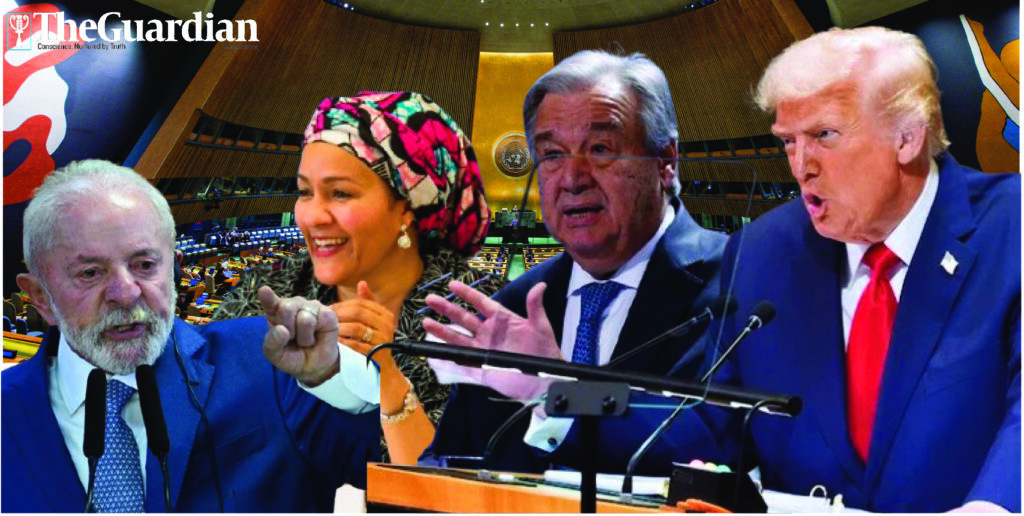
UN Secretary-General António Guterres warned that aid cuts are “wreaking havoc” on human rights and development, stressing that the world has entered “an age of reckless disruption and relentless human suffering.”
“For every dollar invested in peace, the world spends $750 on weapons of war,” he lamented, urging member states to recommit to peace, human dignity, climate action, and financial justice.
Guterres’ Key Messages
Called for reform of the international financial system to support vulnerable nations.
Urged a permanent ceasefire in Gaza, the release of hostages, and a two-state solution.
Warned that the climate crisis requires scaled-up finance, including $1.3 trillion annually for developing countries by 2035.
Advocated for stronger regulation of artificial intelligence, declaring: “No company should be above the law. No machine should decide who lives or dies.”
President of the General Assembly, Annalena Baerbock of Germany, stressed that the UN Charter is only as strong as member states’ commitment to uphold it. She described the UN as “a compass pointing towards peace, humanity, and justice” but cautioned that without unity and reform, its credibility is at risk.
Donald Trump, former U.S. president, made immigration the centerpiece of his remarks, vowing jail terms for illegal entrants and accusing the UN of undermining U.S. sovereignty.
Luiz Inácio Lula da Silva, Brazil’s president, warned of rising autocracy, urged a global fight against hunger and poverty, and called for stronger regulation of digital platforms.
President Bola Tinubu, represented by Vice President Kashim Shettima, called for Africa to finance its mineral wealth and wield collective power in global supply chains. He pledged Nigeria’s commitment to a “mineral-led renaissance” under the Renewed Hope Agenda.
Shettima separately highlighted Nigeria’s positioning as the hub for the AfCFTA’s $3.4 trillion market, citing economic reforms, upgraded ratings, and $50 billion in new investment interest.
As the UN marks 80 years, leaders agreed that the institution’s survival and relevance depend on reform, unity, and the political will to act.