Tinubu’s 2027 Re-Election Moves Spark Widespread Backlash Amid Soaring Hardship
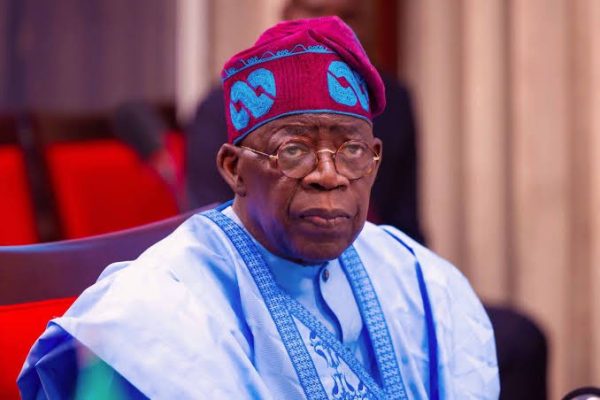
President Bola Tinubu’s early re-election activities have come under heavy fire from opposition parties, former presidential aspirants, and political commentators, who accuse the administration of prioritising power retention over governance amid deepening national crises.
The African Democratic Congress (ADC), in a statement by its National Publicity Secretary, Bolaji Abdullahi, condemned what it described as “choreographed endorsements” from various states, saying they violate the Electoral Act and INEC regulations, which prohibit campaigns until 150 days before an election.
“While the ruling party chants ‘four more years’ and sings songs of a sinking mandate, inflation has galloped beyond the reach of ordinary citizens,” Abdullahi said.
The party noted that inflation, which hit 35% in December 2024, remains over 22% in 2025, with costs of food, rent, and transport skyrocketing by over 60% since Tinubu took office. It also cited a naira collapse from ₦461/$ in early 2023 to over ₦1,500/$, coupled with rising petrol prices (over ₦1,000/litre) and worsening insecurity.
The ADC described the administration’s borrowing as unsustainable, with debt servicing now exceeding revenue, according to World Bank projections.
On security, it highlighted over 1,800 civilian deaths and 122 security personnel casualties between April and June 2025, as well as a mass abduction of over 50 people in Zamfara’s Sabon Gari Dirmi community.
“Our streets are lined not with security personnel but with Tinubu’s campaign billboards,” Abdullahi said, accusing the administration of prioritising propaganda over public service.
He called for the dismantling of the “illegal campaign machinery” and pledged that the ADC would challenge the ruling party both publicly and at the polls.
Charles Udeogaranya, a former APC presidential aspirant, echoed similar concerns, warning Tinubu to “go low” and silence his re-election ambition for now.
“Now is the time for governance—at least until June 2026. No responsible democracy thrives on endless campaigns at the expense of leadership and development,” he said.
He described the early politicking by Tinubu’s allies as a dangerous distraction and a violation of the Electoral Act, aligning with recent warnings by INEC, which condemned “the growing proliferation of political posters, subtle endorsements, and intensifying verbal confrontations.”
Udeogaranya also criticised the diversion of public funds toward political mobilisation while the country’s critical sectors remain underfunded.
In a related development, Labour Party leader, Peter Obi, condemned the Federal Government’s approval of ₦712.3 billion for airport renovations while 34 million Nigerians face food insecurity.
“It is profoundly troubling that at a time when millions are battling hunger and hardship, the government chooses to spend ₦712 billion not to feed the people or lift them out of poverty, but to renovate an airport,” Obi said on X (formerly Twitter).
Obi recalled a $500 million loan taken in 2013 to upgrade five international airports, questioning the need for a larger budget now for fewer results. He insisted that development is about choices, adding:
“A government that builds grandiose infrastructure while its people starve is not building a nation—it is betraying one.”
He called for urgent redirection of resources to agriculture, healthcare, education, and poverty alleviation, declaring:
“Every budget is a statement of values. What message are we sending when airports take precedence over lives?”
Secondus: Tinubu Steering Nigeria Towards Economic and Democratic Collapse
Also weighing in, former PDP National Chairman, Uche Secondus, accused Tinubu of liquidating Nigeria’s democracy and economy.
Speaking at a book launch in Abuja, Secondus lamented that Nigeria’s democracy has been reduced to a platform for winning elections, lacking ideological coherence or institutional continuity.
“We are far from the kind of democracy that builds nations. What we have is just a platform for election victories,” he said.
He criticised the frequent party-switching among politicians and the absence of long-term political institutions, urging leaders to invest in building sustainable structures rather than temporary coalitions of convenience.
“Until we establish real political parties where people can commit 30, 40, 50 years, Nigeria will not move forward,” he concluded.