Solar Panel Import Ban May Spike Prices by 150%, Deepen Energy Crisis in Nigeria
Nigeria is facing the possibility of a 150 per cent surge in solar installation costs, a slowdown in its energy transition, and worsening electricity challenges as the Federal Government finalises plans to ban the importation of solar panels.
The move could significantly aggravate the already high energy poverty levels and escalate the cost of doing business, especially as many small enterprises increasingly turn to renewable energy to escape soaring electricity costs.
Despite planned solar panel assembly plants with a combined capacity of about 1,531 megawatts across Lagos, Enugu, Nasarawa, and other locations, stakeholders have expressed fears that major oil companies such as Oando, Shell-backed Auxano, LPV Technologies, and the National Agency for Science and Engineering Infrastructure (NASENI) may dominate the emerging $50 billion solar market, forming a potential cartel.
Industry players have urged the government to reconsider the ban, warning it could undermine efforts by states and individuals relying on off-grid solutions amidst persistent national grid failures.
Currently, a 100W 12V polycrystalline solar panel, imported into Nigeria at around N22,000, is sold by local manufacturers like NASENI for about N28,000, creating a cost gap of N6,000, according to Gbenga Olapade, Managing Director of Deemich Renewable Energy Nigeria Limited.
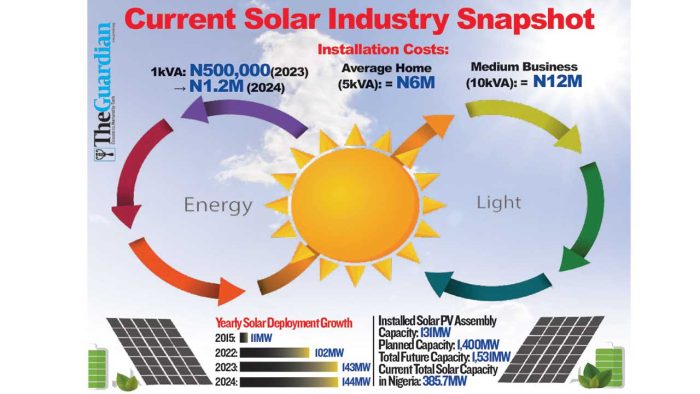
The ongoing foreign exchange and inflation crises had already driven the cost of deploying solar systems by more than 50 per cent compared to early 2023. Homes and businesses now pay between N1.2 million and N12 million for basic solar setups, depending on size and energy demand.
Olapade warned that the ban could stifle the growing patronage of solar energy systems, fueled recently by the high costs of petrol, diesel, and public electricity tariffs.
The Rural Electrification Agency (REA) noted that over N200 billion has been spent on solar imports in Nigeria. If the imports had been sourced locally, the cost would have ballooned to about N254.54 billion.
According to the International Renewable Energy Agency (IRENA), Nigeria’s solar energy deployment rose from 11MW in 2015 to 144MW by 2024, but it remains far below the needed levels. Most solar panels are currently imported from China, helping to keep prices relatively lower.
While Nigeria’s local solar PV assembly capacity stands at just 131MW, planned expansions aim to reach about 1,531MW. However, this still pales in comparison to the energy demands of Africa’s most populous nation.
Oando Clean Energy is developing a 1,200MW solar assembly plant in partnership with the REA, while LPV Technologies and Auxano Solar have set up 100MW and 110MW plants respectively. NASENI and other players are also developing large-scale facilities in Nasarawa and Enugu states.
Despite these efforts, experts like Dr. Adedoyin Adeleke of Green Growth Africa warned that Nigeria risks repeating past policy mistakes. He argued that without strengthening local capacity and ensuring high product quality, banning imports could lead to increased prices, poor quality products, and market instability.
Former CIBN President, Prof. Segun Ajibola, questioned the wisdom of the policy, while NES President, Prof. Adeola Adenikinju, called for a phased and data-driven approach instead of an outright ban.
Similarly, Adetayo Adegbemle, Executive Director of PowerUp Nigeria, warned that a ban could trigger smuggling and higher inflation, much like previous failed attempts to restrict food imports.
Government officials, including the Minister of Science and Technology, Uche Nnaji, and REA Managing Director, Abba Aliyu, maintain that boosting local production is necessary. However, the Renewable Energy Association of Nigeria (REAN) emphasized that enabling business-friendly conditions must precede any import restrictions to avoid harming the industry they seek to grow.








Very good https://rb.gy/4gq2o4
Awesome https://is.gd/N1ikS2