Sokoto Residents Turn to Ice Blocks for Relief Amid Extreme Heat and Power Failures
By: Titilope Johnson
Sweat trickled down Hauwau Suleman’s face as she sat outside her shop in Upper Road, Sokoto Metropolis. Dabbed with the hem of her multicoloured hijab, her forehead quickly became damp again under the scorching midday sun. The temperature had hit 40 degrees Celsius in May, with forecasts predicting a rise to 42 degrees later in the day.
Suleman, who sells drinks and sews clothes, had just returned empty-handed from a military barracks where she sought ice blocks to keep cool. Though her cooler remained without ice, the aches in her calves and heels were painful reminders of the futile trip.
Far away, Ibrahim Gobir, a 31-year-old teacher, escaped the heat by sitting under a tree at his school. His office ceiling fan was motionless due to a lack of electricity, offering no respite from the oppressive heat.
“Heat Like Hell”
Sokoto, like much of Northern Nigeria, is known for its high temperatures most of the year. The Nigerian Meteorological Agency (NiMet) notes that northern states typically receive around 180 days of rainfall annually. Yet, The Guardian found that Sokoto had only experienced a few rainy days in early 2025.
For weeks, temperatures hovered between 42 and 43 degrees Celsius, with early mornings around 38 to 39 degrees. Aliu (a pseudonym), a local journalist, described the heat as a “gateway to hell,” saying he struggled to even concentrate indoors.
Gobir echoed the sentiment:
“The heat in Sokoto recently has been as if it came from hell. Babies cry, and people bathe repeatedly just to stay cool. This heat is worse than last year.”
Extreme heat is not new to Sokoto; April 2019 saw similar temperatures between 40 to 42 degrees Celsius.
Signs and Risks of Extreme Heat
According to Casey Ivanovich, a researcher at NASA’s Goddard Institute for Space Studies, extreme heat is defined as unusually high temperatures, either absolute (like 40°C) or relative to historical records.
In Nigeria, temperatures above 38 degrees Celsius are considered extreme. Such heat poses serious health risks including dehydration, kidney injury, cardiovascular problems, heat stroke, dizziness, nausea, headaches, skin rashes, and in severe cases, death.
In May 2024, an extreme heatwave in Adamawa State caused at least 200 deaths over two weeks.
While The Guardian found no heat-related deaths in Sokoto, residents reported discomfort, headaches, stomach pain, and fever.
Power Failures Worsen the Situation
The heat’s burden is amplified by unreliable electricity. Many parts of Sokoto receive power only two or three hours daily, sometimes going days without supply.
Gobir recounted sleepless nights sweating under a non-functioning fan. Trader Mariam Nofiu complained of weakness, headaches, and stomach pains during the heat.
Lack of stable power leaves many without fans or air conditioners, forcing them to endure unbearable heat.
Ice Blocks: A Lifeline for Many
With electricity scarce and fuel costs soaring—petrol prices surged from N238 per litre in early 2023 to over N1,000 by year-end—many turn to alternative cooling methods.
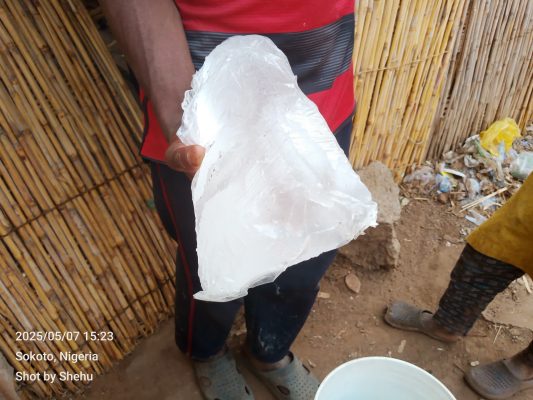
Sani Maigari, an ice block seller, stands by a road in Mabara, selling frozen sachets of water (“pure water”) to eager customers. For many Sokoto residents, buying ice blocks is the only affordable way to cool down.
Teachers like Gobir carry jugs filled with water and ice blocks to school, sipping slowly to avoid dehydration. Others add ice blocks to bathing water for relief.
Financial Strain and Survival
Buying ice blocks is costly for many. Gobir admitted he once had to choose between cooking charcoal and ice blocks, affecting his household budget.
“If the power was stable, I could freeze ice at home and use fans. Now, the money I spend chasing ice blocks could be used for other essentials.”
A Booming Ice Block Business
The sale of ice blocks thrives during hot spells. Sellers like Maigari make between N15,000 and N20,000 daily, while larger vendors can earn up to N80,000 per day.
Umar Bello, an ice block trader in Mai Ruwa, said prices vary by size: small blocks go for N100, while larger ones fetch up to N400 during peak heat. In the rainy season, prices drop as demand wanes.
Looking Ahead
NiMet forecasts 110 to 150 rainy days this year for Sokoto, but until reliable electricity returns, residents will rely on ice blocks and other makeshift solutions to survive the heat.





