Refineries, Ajaokuta Steel Remain Idle Despite ₦6.5 Trillion Spent in 10 Years
By Titilope Johnson
Despite spending over ₦6.5 trillion on turnaround maintenance and revival projects in the past decade, Nigeria’s state-owned refineries and Ajaokuta Steel Complex remain dormant, raising renewed concerns over corruption, mismanagement, and policy inconsistency.
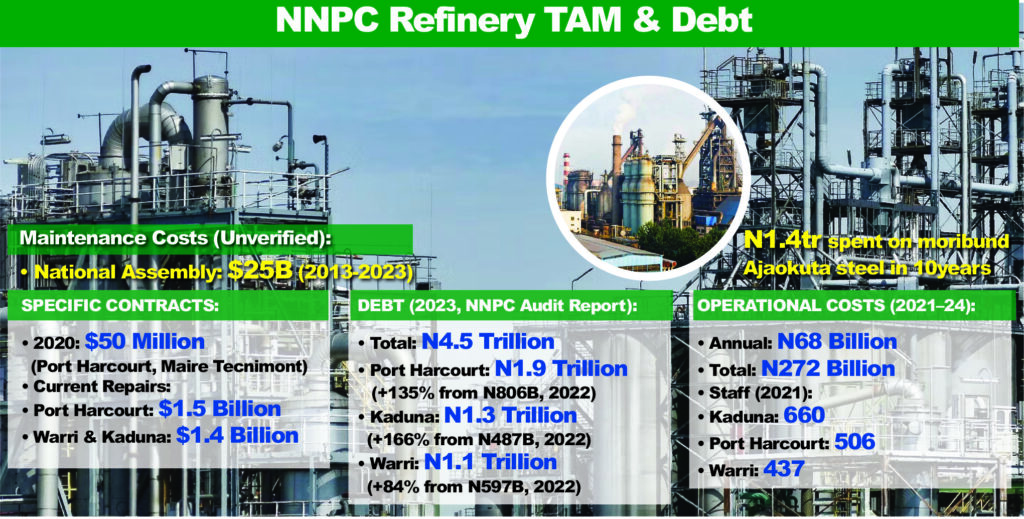
The Nigerian National Petroleum Company Limited (NNPC Ltd) faces mounting criticism as its three major refineries—Port Harcourt, Warri, and Kaduna—remain idle despite a combined rehabilitation bill exceeding $3.4 billion (₦5.2 trillion) in the last five years. Recent financial reports reveal that the refineries collectively owe ₦4.5 trillion, with Port Harcourt alone accounting for ₦1.9 trillion.
Ajaokuta Steel Complex, conceived nearly 50 years ago as a symbol of Nigeria’s industrial ambition, has consumed ₦1.43 trillion between 2016 and 2024 through salaries, settlements, and failed revival plans—yet has never produced commercial steel.
The crisis deepened after NNPC suspended contractors and admitted to a review of its refinery strategy, hinting at a possible sale of the facilities. Industry sources suggest that the refineries may only attract scrap value, posing a severe fiscal risk if outstanding liabilities are not addressed.
Group CEO Bayo Ojulari told Bloomberg that the company is reassessing its refinery plan after years of technical setbacks, fueling speculation that privatization or asset disposal could follow by the end of 2025.
Documents reviewed by The Guardian show that the Port Harcourt refinery shutdown—officially attributed to planned maintenance—was linked to a $300,000 jetty repair. Yet, the plant has remained idle for nearly two months, despite holding over 270 million litres of refined products worth $300 million.
Meanwhile, anti-graft agencies are reportedly investigating fraud allegations involving an Italian engineering firm contracted for the refinery overhaul.
Energy and finance experts warn that outright sale of refineries in their current state could lead to significant financial losses. Professor Godwin Oyedokun stressed that any divestment would fall short of offsetting liabilities, requiring government intervention or restructuring with lenders.
Petroleum economist Prof. Wumi Iledare cautioned against hasty decisions:
“The problem has never been ownership, but governance. Selling without reforms will repeat past mistakes,” he said, advocating public-private partnerships or performance-based concessions.
Former CIBN president Prof. Segun Ajibola called for international consultants to manage the refineries, while Dr. Diran Fawibe argued that if credible buyers emerge, privatization could offer relief:
“Leaving these assets idle and debt-ridden is worse than selling them transparently,” he said.
Past governments have spent billions on turnaround maintenance (TAM) with little to show. Records indicate:
₦272 billion spent maintaining non-functional refineries between 2021 and 2024 on salaries and overheads
7,338 NNPC staff, with 1,603 stationed at idle refineries
Employee benefits ballooned to ₦583.8 billion in 2023 from ₦266.9 billion in 2022
Despite these costs, Nigeria’s refining capacity remains near zero, forcing continued reliance on imports—even as Dangote Refinery and modular refineries enter the market.







