Nigeria Tops Global List of Countries with Extreme Poverty Under Tinubu – World Bank
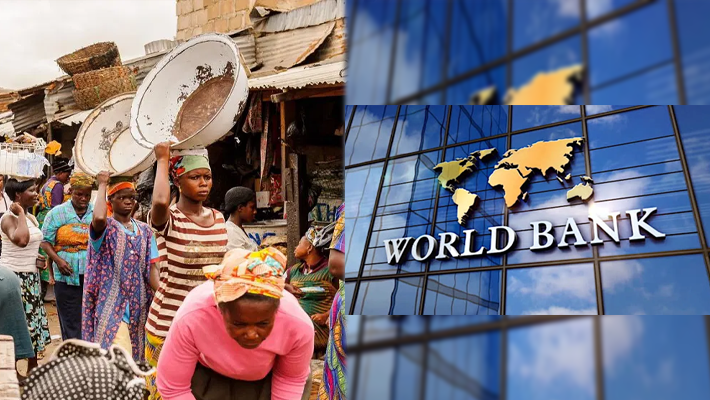
Nigeria, under the leadership of President Bola Tinubu, now has the highest number of extremely poor people in the world, according to the World Bank’s Africa’s Pulse report released in April 2025.
The report reveals that Nigeria accounts for 19% of extremely poor individuals in Sub-Saharan Africa, surpassing the Democratic Republic of Congo (14%), Ethiopia (9%), and Sudan (6%).
“Sub-Saharan Africa has the highest extreme poverty rate globally, and a large share of the poor is concentrated in a few countries,” the report stated.
The World Bank further noted that 80% of the estimated 695 million people living in extreme poverty in 2024 were in Sub-Saharan Africa. Comparatively, only 8% were in South Asia, 2% in East Asia and the Pacific, 5% in the Middle East and North Africa, and 3% in Latin America and the Caribbean.
A breakdown by Peoples Gazette shows that Nigeria’s 19% share of Sub-Saharan Africa’s 560 million extremely poor people equates to approximately 106 million Nigerians, or 15.25% of the global total.
The report identified Nigeria, the Democratic Republic of Congo, Ethiopia, and conflict-ridden Sudan as the four countries that together account for half of Sub-Saharan Africa’s extreme poor.
Looking ahead, the World Bank painted a bleak picture, projecting that more Nigerians will fall into poverty by 2027 if current conditions persist.
Adding to the concern, the International Monetary Fund (IMF) recently reported that President Tinubu’s economic reforms have yet to bring visible relief to most Nigerians. Poverty and food insecurity, the IMF noted, remain widespread.
While acknowledging that some reforms have positioned Nigeria better to handle global economic challenges, the IMF warned that the country still faces significant economic uncertainty.
“The outlook is marked by significant uncertainty. Elevated global risk sentiment and lower oil prices impact the Nigerian economy,” the IMF said. “Looking ahead, macroeconomic policies need to further strengthen buffers and resilience, while creating enabling conditions for private sector-led growth.”