Makinde, PDP and the High-Stakes Battle for Succession in Oyo
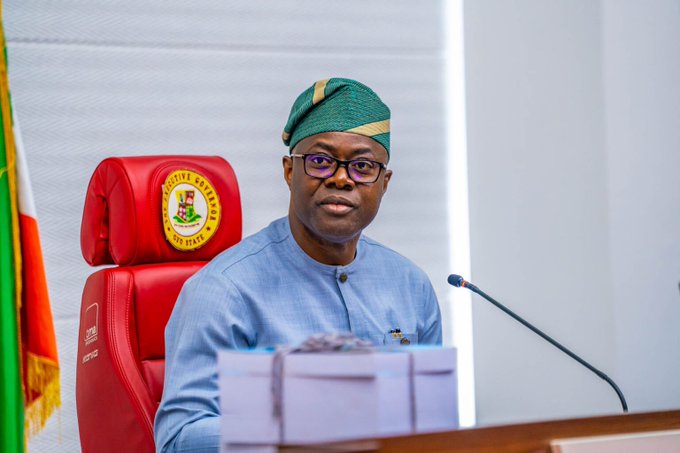
Governor Seyi Makinde of the ruling Peoples Democratic Party (PDP) faces a daunting challenge in his quest to produce a credible successor on a crisis-ridden platform—reawakening Oyo’s long-standing political jinx where outgoing governors struggle to determine who takes over after them.
As preparations for the next gubernatorial election intensify and political parties finalise arrangements for their congresses, Makinde confronts four major obstacles that will define both the selection of his preferred successor and the stability of the PDP ahead of 2027.
The first hurdle is the unresolved crisis within the PDP at the national level. With two factions laying claim to the party’s leadership and multiple cases in court, the uncertainty threatens its ability to field candidates if not resolved. The turbulence is already impacting states like Osun and may soon spill heavily into Oyo.
Secondly, the Oyo PDP is sharply fractured. Many stakeholders accuse Makinde of running a “one-man show,” which has fuelled discontent and weakened party unity ahead of party congresses and the 2027 elections.
Makinde also faces a resurgent All Progressives Congress (APC), which is aggressively reconciling warring factions. With federal influence and President Bola Tinubu’s interest in reclaiming Oyo to strengthen his 2027 re-election bid, the APC is poised to exploit any PDP weaknesses.
Fourth is the new electoral climate under INEC’s new Chairman, Prof. Joash Amupitan. With stricter BVAS deployment and enhanced transparency, elections are expected to be more competitive, making grassroots legitimacy crucial.
Together, these factors set up a subtle power contest between Makinde and President Tinubu, both determined to control Oyo’s political direction in 2027.
History suggests Makinde’s ambition to produce a successor will be an uphill battle. No governor in Oyo since 1999 has successfully installed a preferred successor:
Lam Adesina (1999-2003): Lost re-election and failed to produce a successor due to internal divisions and rising PDP influence.
Rashidi Ladoja (2003-2007): Weakened by the Adedibu-orchestrated impeachment saga; unable to secure a second term or determine his successor.
Adebayo Alao-Akala (2007-2011): Internal PDP resistance and a public desire for change prevented him from installing a successor.
Abiola Ajimobi (2011-2019): Despite his stronghold on Oyo politics, Ajimobi’s attempt to install Adebayo Adelabu in 2019 failed in the face of internal APC rebellion and the coalition that backed Makinde.
With 2027 approaching, analysts warn that Oyo’s succession politics rarely favour incumbents.
The PDP’s internal split—between the Makinde-aligned bloc led by National Chairman Kabiru Turaki and National Secretary Taofeek Arapaja, and the rival faction led by FCT Minister Nyesom Wike, with Abdulrahman Mohammed and Samuel Anyanwu—remains unresolved.
Analysts like Dele Fanimo warn that any congresses held before reconciliation risk being nullified by courts or INEC, posing a major dilemma for Makinde.
Political experts offer mixed assessments of Makinde’s chances:
Dr. Ayantayo Ojo (Kola Daisi University):
“Makinde is not grooming a successor with broad party loyalty. With a deeply fractionalised PDP, it will be hard to raise a strong candidate.”
Dr. Yemi Farounbi (former Ambassador):
“Without resolving the national crisis, the PDP risks failing to present candidates. The instability is greater than Oyo.”
Prof. Olumuyiwa Familusi (University of Ibadan):
“It’s possible for Makinde to find a successor, but internal democracy must not be sacrificed.”
Prof. Dhikru Yagboyaju (University of Ibadan):
“Fifteen months is a long time in politics, but the 2027 race will not be as smooth as 2019.”
Despite Makinde’s strong popularity driven by investments in infrastructure, security, education and welfare, experts caution that popularity alone cannot overcome party fractures and rival ambitions.
Though the APC is eager to reclaim Oyo, many analysts doubt its organisational strength.
Dr. Farounbi:
“APC remains factionalised and lacks cohesion. Only a total PDP collapse can hand it victory.”
Prof Familusi:
“National power does not always translate to local dominance. The APC must not forget what happened in 2019.”
Others, however, argue the APC is capitalising on PDP’s crisis.
Makinde’s remark that anyone above 52 would not be considered as his successor triggered strong backlash, with the APC calling it “arrogant” and an attempt to predetermine the process.
It also revived zoning demands. Former Minister Adebayo Shittu insists that Oke-Ogun must produce the next governor, arguing that Ibadan’s dominance since 1999 is no longer acceptable.
Stakeholders across Oke-Ogun, Ogbomoso and Oyo zones insist on a more equitable rotation of power in 2027.
Makinde enters the succession battle with significant achievements and considerable goodwill, but he faces unprecedented internal fractures, national PDP instability, emboldened opposition, and a more stringent electoral environment.
Whether he can finally break Oyo’s 26-year succession jinx remains uncertain.