FG Declares National Emergency on Food Security, Targets Irrigation Overhaul
President Bola Tinubu has declared a national emergency on food security, calling for accelerated development of irrigation infrastructure and inclusive water resource management across Nigeria.
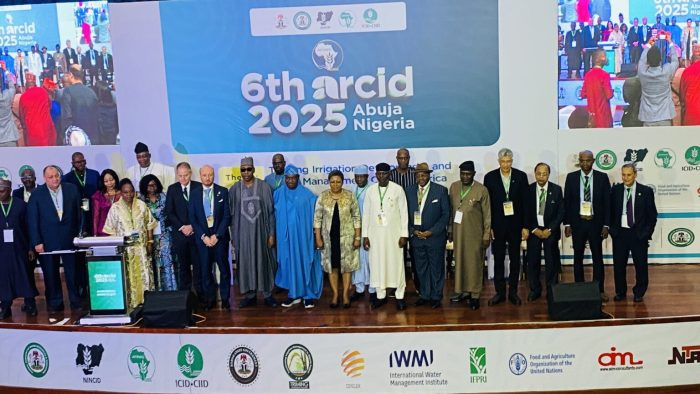
The announcement was made on Monday during the opening of the 6th African Regional Conference on Irrigation and Drainage in Abuja. Tinubu, represented by Secretary to the Government of the Federation, Senator George Akume, urged African nations to embrace innovative strategies to tackle the continent’s irrigation and water challenges.
Describing the conference theme, “Tackling Irrigation Development and Water Management Crisis in Africa,” as a wake-up call, the president stressed the urgency of coordinated action for sustainable agriculture and economic resilience.
“Africa continues to face major challenges in unlocking its irrigation potential due to inadequate infrastructure, financial constraints, climate change, and governance issues,” Tinubu said. “This conference offers a vital platform for us to collectively chart a path forward.”
Tinubu noted that Nigeria holds over 3.1 million hectares of irrigable land, particularly around major river basins like the Niger and Benue.
New Projects and Progress
Minister of Water Resources and Sanitation, Prof. Joseph Utsev, highlighted key achievements under the Transforming Irrigation Management in Nigeria (TRIMING) project, which has delivered results in various states and is nearing completion.
He announced a successor project, Sustainable Power and Irrigation for Nigeria (SPIN), to be implemented with World Bank support.
“With TRIMING winding down, Nigeria is poised to begin SPIN. This initiative will expand our irrigation potential and optimise our water resources for food security,” Utsev said.
Notable TRIMING achievements include completion of Dadin-Kowa and Bakolori irrigation schemes, and 90% completion of the Middle Rima Valley project. Interventions are ongoing in Ondo, Kwara, Benue, Kebbi, Edo, Adamawa, and Oyo States.
The ministry has also supported the creation of Water Users Associations (WUAs), farmer management centers, and improved market linkages for crops like rice and tomato.
Broader Efforts and Stakeholder Contributions
River Basin Development Authorities have reportedly developed over 153,000 hectares of irrigable land, with steps being taken to commercialise operations and attract private sector investments. A 2025 Flood Outlook and Risk Management Strategy is also in place to mitigate flood impacts on agriculture.
Head of Civil Service, Dr. Didi Wilson-Jack, emphasized the need for all tiers of government to commit to food security, while former Water Resources Permanent Secretary, Mr. Godknows Igali, highlighted the urgency of planning and local government involvement.
Governor Babagana Zulum of Borno expressed concern over shrinking farming seasons and unpredictable rainfall, calling irrigation a necessity:
“Our fertile lands are turning to dust. Innovation must not be a privilege of the few—we must empower women and youth on the frontlines of agriculture,” Zulum said.
He appealed to development partners for increased support in water access and rural farming.
International Support
President of the International Commission on Irrigation and Drainage (ICID), Dr. Marco Arcieri, called the conference “a turning point” and reaffirmed ICID’s commitment to supporting Africa amid climate and population challenges.
The conference continues in Abuja until April 17, featuring technical sessions, policy dialogues, and field visits to irrigation sites across Nigeria.