FG Approves ₦3.8 Trillion Plan to Repair Third Mainland Bridge – Umahi
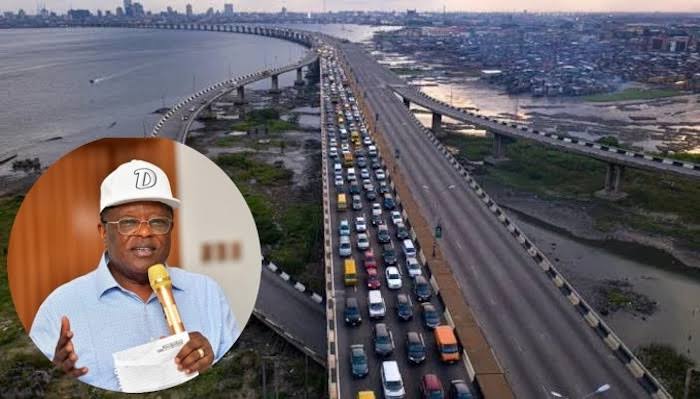
The Federal Government has announced that the structural rehabilitation of Lagos’ iconic Third Mainland Bridge will cost an estimated ₦3.8 trillion.
Minister of Works David Umahi disclosed this after the Federal Executive Council (FEC) meeting in Abuja, explaining that underwater and structural assessments revealed severe damage to the bridge’s piles and piers caused by illegal sand mining, erosion, and long-term corrosion.
“The rehabilitation is estimated at ₦3.8 trillion, while a complete rebuild would cost about ₦3.6 trillion,” Umahi said.
“We have approval for at least seven specialist contractors to conduct detailed investigations, prepare designs, and submit bids for either rehabilitation or new construction under an EPC+F [Engineering, Procurement, Construction, and Financing] arrangement.”
The findings mirror earlier reports on the Carter Bridge, which was declared beyond repair. Julius Berger, the contractor on that project, recommended full replacement at a cost of ₦359 billion.
Umahi noted that the government will invite public-private partnership bids while also holding talks with international financiers, including Deutsche Bank, to fund the Lagos bridge projects.
Urgent Structural Concerns
Inaugurated in 1990, the Third Mainland Bridge remains Nigeria’s longest and one of Lagos’ most vital transport arteries, carrying hundreds of thousands of vehicles daily. Despite periodic maintenance works, recent inspections revealed far more extensive damage than previously recorded.
“The underwater problems are compounded by decades of neglect and human activity that have weakened the substructure,” Umahi said. “We cannot delay. Both rehabilitation and reconstruction demand specialised engineering and significant resources.”
Wider Bridge Repairs Across Nigeria
Beyond Lagos, FEC approved emergency works on several other damaged bridges, including:
Jalingo Bridge (Taraba State)
Ido Bridge (damaged by fire)
Keffi Flyover (Nasarawa State)
Mokwa Bridge (Niger State)
Abuja–Kogi route bridges
Bridges along Lagos–Ibadan corridor (damaged by vehicular impact)
Jebba Bridge (Kwara State)
Itokin–Ikorodu Bridge (Lagos State)
These projects will be documented and forwarded to the President through the Ministry of Finance for approval.
Additional Major Road Projects
The FEC also allocated ₦493 billion for two critical infrastructure works:
Kano–Katsina Road Upgrade (152 km)
Construction of a new Carter Bridge
The Kano–Katsina Road, split into two sections, has undergone multiple cost revisions due to economic pressures. Section One now costs ₦68 billion (up from ₦24 billion), while Section Two stands at ₦66.115 billion (up from ₦46 billion). Budget allocations include ₦6 billion (2024) and ₦34 billion (2025) for Section One, with ₦80 billion earmarked for Section Two over the same period.
Umahi stressed that large-scale infrastructure cannot rely solely on federal budget allocations, hence the shift to EPC+F models and PPP arrangements to attract private investment while retaining government oversight.