Economic Recovery: Nigeria ‘Not Broke’ but Fiscal Fragility Persists
Nigeria’s external reserves climbed to multi-year highs this month, offering a buffer against immediate shocks. Yet analysts warn that reserves alone cannot cure structural weaknesses driven by fiscal imbalance and poor governance. While officials insist “Nigeria is not broke,” deep fiscal concerns continue to erode confidence in the nation’s financial stability.
From Argentina to Ghana, global history shows that sovereign bankruptcy rarely occurs overnight. Instead, it follows a predictable path: rising domestic yields, crowding out of private investment, depletion of reserves, debt restructuring, and eventual default. Nigeria, despite escaping past crises, appears to be tracking the same playbook.
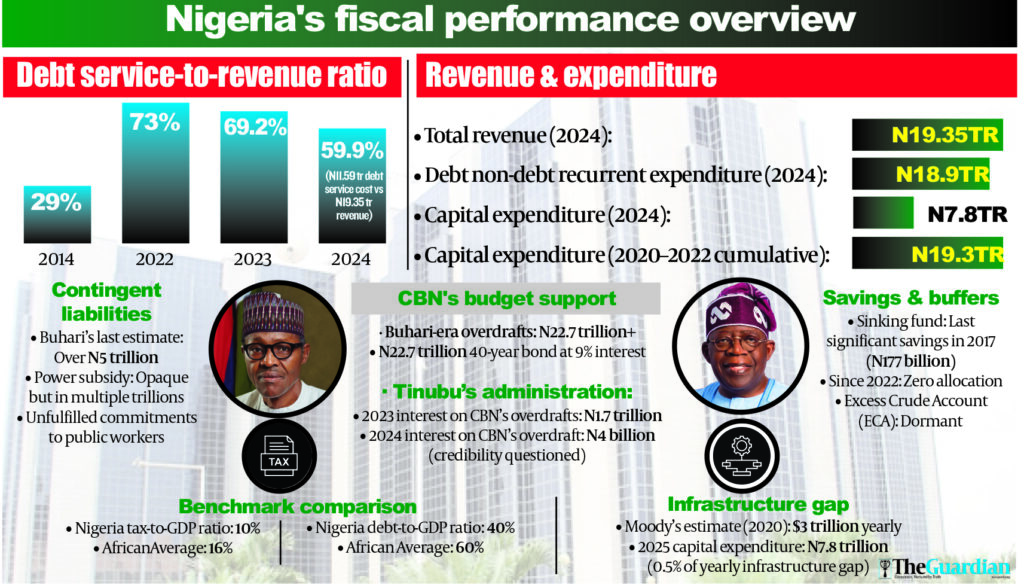
Nigeria spent ₦11.59 trillion servicing debt last year, nearly 60% of total revenues. Though an improvement from the 69% ratio in 2023, the long-term trajectory remains troubling. Just a decade earlier, debt service consumed only 29% of revenues. Analysts warn the recent reprieve may be masking deeper structural fragilities, including undisclosed liabilities to the Central Bank of Nigeria (CBN).
By Q1 2025, public debt ballooned to ₦150 trillion (40.3% of GDP). While this appears low compared to the global average of 235%, Nigeria’s weak tax base — only 10% of GDP — undermines sustainability. In contrast, Ghana and Kenya, with higher debt ratios, generate far more revenue relative to GDP.
Fiscal Indiscipline and Selective Disclosure
Experts point to lapses in fiscal transparency. Questions linger over the securitisation of ₦22.7 trillion Ways and Means overdrafts into long-term bonds, with conflicting accounts of repayment obligations. Official reports show as little as ₦4 billion spent servicing these debts in 2024, fuelling concerns over credibility and selective disclosure.
Economists remain divided. Former MPC member Prof. Adeola Adenikinju insists Nigeria is not broke, citing a 40% surge in half-year revenues. Non-oil revenues alone reached ₦20.59 trillion between January and August 2025. Yet others, like Dr. Chiwuike Uba, caution that while revenues are improving, the government still operates under “severe fiscal constraints.”
Beyond explicit debt, Nigeria carries massive off-balance-sheet liabilities, including trillions in power subsidies and unpaid obligations to workers across sectors. Economists warn that governance failures — from politically-charged spending to lack of fiscal discipline — pose the greatest risk to sustainability.
While Nigeria has so far avoided insolvency, the warning signs are clear. A sudden drop in oil prices, a halt in capital inflows, or a spike in global interest rates could quickly expose the nation’s fragile underbelly. For now, the country treads a fine line between resilience and fiscal recklessness — its future hinging less on luck than on decisive policy choices.





