Chaos Erupts as Umahi Defends ₦3.4 Trillion Works Budget at National Assembly
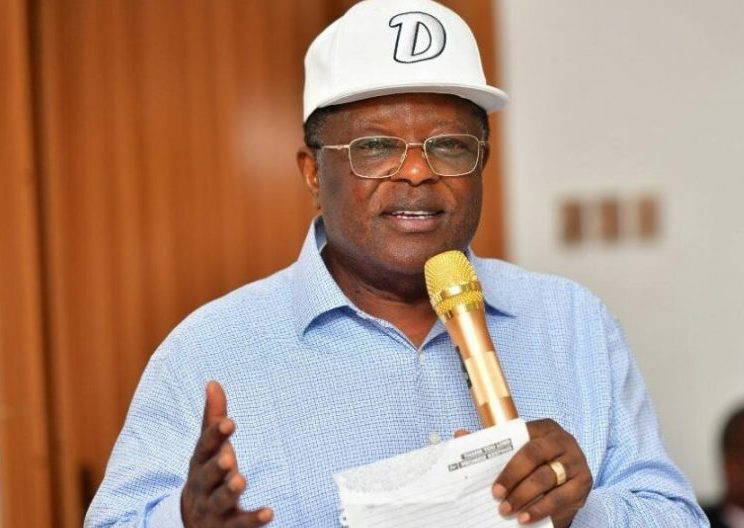
Chaos erupted at the National Assembly on Wednesday as Minister of Works, David Umahi, defended his ministry’s ₦3.4 trillion 2026 budget, triggering heated exchanges, procedural disruptions, and open confrontations among lawmakers over road contracts, budget priorities, and accountability.
The Joint Committees on Works of the Senate and House of Representatives convened to scrutinize the ministry’s proposed capital expenditure and assess ongoing projects. What began as a routine budget defence—focused on over ₦3.2 trillion for federal road infrastructure—quickly degenerated into disorder as lawmakers openly challenged the minister’s explanations.
Tensions peaked during a sharp exchange between Umahi and Senator Adams Oshiomhole (APC, Edo North), who questioned the controversial reassignment of the Abuja–Kaduna–Zaria–Kano Road from construction giant Julius Berger to Maikano, a firm known more for generator manufacturing than highway construction.
Oshiomhole demanded clarity on the contractor’s technical competence, transparency, and value for money for one of Nigeria’s most strategic road corridors. In response, Umahi dismissed the concerns and challenged lawmakers to inspect the project firsthand, vowing to resign if it failed quality standards.
“I invite the committee to visit the site. If the road is not up to standard, I will throw in the towel,” Umahi said, insisting he had full confidence in the contractor’s work.
The session quickly shifted from policy scrutiny to legislative showdown when Senator Onyekachi Nwaebonyi (APC, Ebonyi North) clashed with Deputy Minority Whip, Senator Rufai Hanga (NNPP, Kano Central), over control of proceedings. Nwaebonyi, who largely praised Umahi and urged support for the ministry, was cautioned by Hanga to conclude his remarks.
“You cannot stop me from speaking after allowing Senator Oshiomhole to talk for 15 solid minutes uninterrupted. I have barely spent five minutes, yet you are telling me to round up,” Nwaebonyi shot back. “For your information, as a ranking senator from the ruling party, I can take over proceedings from you.”
Hanga countered angrily, citing his electoral mandate and insisting Nwaebonyi had no authority to assume control. The confrontation drew senior lawmakers, including Senators Ali Ndume (APC, Borno South) and Adamu Aliero (APC, Kebbi Central), who intervened to restore order.
Despite the chaos, Umahi presented a detailed breakdown of the ministry’s budget and ongoing federal road projects. Of the ₦3.245 trillion capital allocation proposed for 2026, ₦760 billion is earmarked for new projects across the six geopolitical zones. These are separate from four legacy projects inherited from previous administrations, including the Akwanga–Jos–Bauchi–Gombe–Maiduguri Road.
Umahi revealed that President Bola Tinubu inherited over 2,000 ongoing projects valued at ₦13 trillion as of May 2023, excluding NNPCL tax-credit projects. He added that an additional ₦7 trillion would be needed to complete these projects, while contractors are owed more than ₦2.2 trillion, causing nationwide delays.
On concerns over seemingly minor ₦14 million entries in the budget, such as the Odukpani–Ikot Ekpene Road, Umahi explained they were accounting placeholders and not reflective of actual project costs. He also lamented poor capital releases in 2025, noting that only about nine per cent of the ₦2.2 trillion allocation was disbursed.
Umahi assured lawmakers that sections of key legacy roads would be ready for commissioning between May and December 2026, provided funding is released. He emphasized that accountability, quality control, and value for money remain top priorities despite fiscal constraints.
Observers noted that the stormy session highlighted lawmakers’ frustration with road funding and project execution. The clash between Nwaebonyi and Hanga underscored the challenge of maintaining legislative scrutiny amid Nigeria’s pressing infrastructure needs.





