Election Campaign Spending Could Strain Naira and Inflation, Warn CBN and Stakeholders
By Titilope Johnson
As Nigeria gears up for the 2027 elections, experts warn that escalating campaign spending could destabilise the naira, drive inflation, and complicate monetary policy. Rising politically-induced liquidity is already threatening to undo the modest price stability achieved since last year.
At a press briefing following the first Monetary Policy Committee (MPC) meeting of 2026, Central Bank of Nigeria (CBN) Governor Yemi Cardoso is expected to outline measures to mitigate market distortions from increased election-related spending. Historical trends show that pre-election years tend to see higher foreign exchange (FX) demand, exerting pressure on the naira and general prices.
Unlike standard economic variables, election expenditures are impulsive and difficult to model, often leading to market distortions. The Minister of Finance, Wale Edun, expressed concern that political spending could erode recent gains in naira appreciation and inflation control. Past election cycles, notably in 2023, saw politicians monopolise dollars in Lagos, Abuja, and other cities, causing the naira to depreciate sharply in the black market to around N900/$, while official rates remained at N460/$.
CBN has urged state governors to maintain fiscal discipline, noting that excessive spending could undermine the reforms that have restored economic stability. Since 2025, the naira has gained about N200 against the dollar, easing import costs and reducing inflation from over 30% to slightly above 15% in January 2026. Aggregate money supply slowed to 9.8% year-on-year growth as of January, reflecting negative credit growth to the private sector.
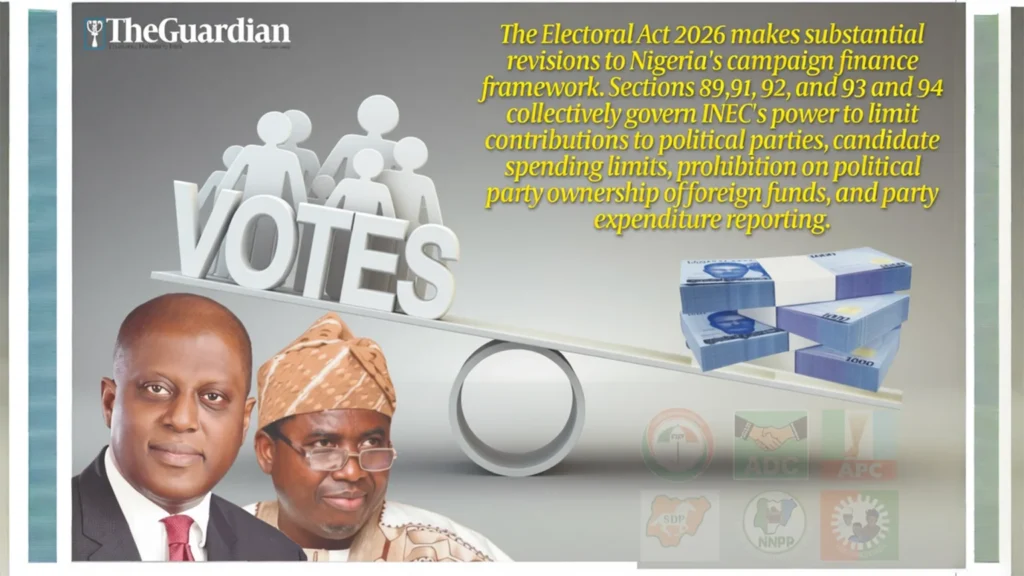
The recently signed Electoral Act 2026, which raises campaign funding limits, has heightened concerns about economic and political risks.
Presidential candidates may now spend up to N10 billion (up from N5 billion), governorship aspirants N3 billion (up from N1 billion), senators N500 million (up from N100 million), and House of Representatives candidates N250 million (up from N70 million). Individual and corporate donations per candidate have risen tenfold from N50 million to N500 million.
The Policy and Legal Advocacy Centre (PLAC) warned that these limits could enable elite capture of electoral financing, widen the influence of political “godfathers,” and reinforce vote-buying. PANDEF and the Ijaw National Congress (INC) added that excessive campaign spending may exacerbate liquidity pressures, deepen corruption, and stress the naira.
Election experts argue that the current N10 billion presidential spending cap is unrealistic given the nationwide scale of campaigns.
Aspirants must tour all 36 states, meet party delegates, visit religious leaders, and engage traditional rulers, incurring costs far exceeding legal limits. Stakeholders also highlighted the prohibitive costs of nomination and expression-of-interest forms, which can range from N10 million to N100 million, effectively excluding ordinary Nigerians from political participation.
Critics emphasised that without credible enforcement, the new law may entrench money politics, widen the gap between the political elite and ordinary citizens, and increase systemic corruption. Questions remain over INEC’s ability to monitor campaign spending effectively, with calls for other agencies, such as the Nigerian Financial Intelligence Unit, to assist.
The consensus among stakeholders is that unless strong regulatory oversight is implemented, the 2027 elections could once again see massive political liquidity, destabilising both the naira and inflation, while reinforcing entrenched political inequalities.





