Don’t Pull the Plug: Nigerians Urge U.S. to Extend Police Training Program and Align It With New Military Deployment
By Kingsley Okafor
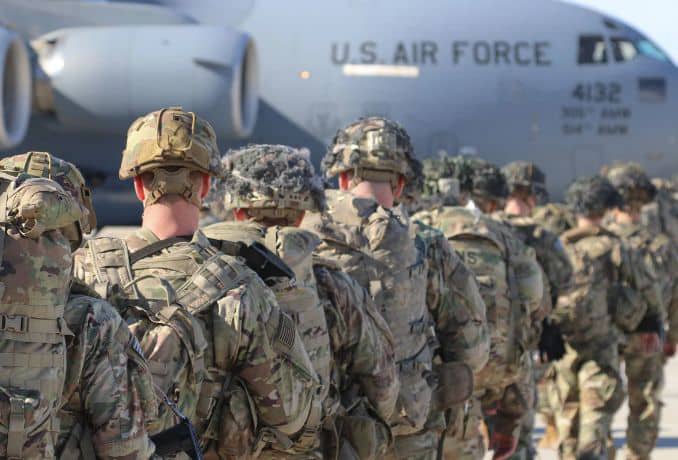
When approximately 100 American troops arrived at Bauchi Airfield in northern Nigeria on February 16, 2026, the deployment immediately attracted global attention. Major international outlets including the , , , and reported on what analysts described as the first large-scale deployment of U.S. military trainers to Nigeria.
The deployment followed U.S. airstrikes targeting Islamic State-linked militants in Sokoto State on Christmas Day 2025, marking a significant shift in Washington’s security engagement with Africa’s most populous nation.
For many Nigerians — particularly communities in the violence-stricken Middle Belt — the arrival of American troops was seen as a long-awaited signal of tangible international support.
“This is the kind of decisive partnership many Nigerians have prayed for,” said a community leader in Plateau State. “For years, people have felt abandoned in the face of insurgency and banditry.”
Yet even as attention focuses on the military deployment, another American-backed initiative is quietly approaching its end — a development that has sparked concern among Nigerian stakeholders.
A Three-Year Policing Partnership at Risk
Under the U.S. Department of State’s Bureau of International Narcotics and Law Enforcement Affairs (INL), retired American law enforcement professionals have spent the past three years working directly with the (NPF).
During that period, more than 400 Nigerian police officers received specialized training across key operational units, including:
- Complaint Response Unit (CRU)
- Counter Terrorism Unit (CTU)
- Mobile Police (MOPOL)
- Special Intervention Squad (SIS)
The curriculum was comprehensive, covering Public Order Management, tactical operations, firearms proficiency, use-of-force standards, human rights compliance, medical first response, leadership development, community policing, de-escalation techniques, and train-the-trainer modules.
Security analysts say the program’s impact extended beyond technical skills.
“This wasn’t just about shooting drills or riot control,” said a senior security consultant in Abuja familiar with the initiative. “It was about building professionalism, accountability, and trust within the policing structure.”
The INL program is currently scheduled to conclude on March 31, 2026.
When contacted, trainers involved in the program declined to comment, explaining they are not authorized to speak publicly on behalf of the U.S. government.
Local Alarm Over Possible Termination
News of the program’s pending expiration has generated concern, particularly in regions that have experienced repeated cycles of herder-farmer clashes, Boko Haram spillover, and organized banditry.
“Nigerians understand that these programs are expensive,” said a civil society advocate in Benue State. “But the cost of instability is far higher. We are appealing to the United States to renew the program until lasting solutions are achieved.”
Observers argue that the progress made within the CTU and SIS units cannot simply be replicated if the program ends.
“Institutional reform takes time,” a retired Nigerian police officer noted. “Three years of relationship-building, knowledge transfer, and cultural understanding cannot be replaced overnight by a new team starting from scratch.”
AFRICOM’s Expanded Role
Meanwhile, the newly deployed U.S. personnel in Bauchi are operating under the mandate of the (AFRICOM).
According to AFRICOM, the troops are providing technical advisory support to Nigerian-led counterterrorism operations. Nigeria’s Defense Headquarters has emphasized that the American presence is advisory rather than combat-oriented.
The deployment follows the passage of the , signed into law by on December 18, 2025. The legislation allocated $413 million to AFRICOM for security operations across Nigeria and the broader African theater.
Security equipment has already been delivered to Nigerian agencies under the expanded framework.
The Risk of a Strategic Disconnect
While many Nigerians welcome the renewed military cooperation, analysts warn of a potential coordination gap between military advisory efforts and police capacity-building.
“There is a real risk of parallel operations without synergy,” said an Abuja-based defense analyst. “If the military mission expands while the police training initiative ends, you create fragmentation in the security architecture.”
The Counter Terrorism Unit (CTU) and Special Intervention Squad (SIS) — both strengthened under the INL program — operate in domains that overlap with AFRICOM’s advisory objectives.
“The police handle high-risk internal operations where military-style tactics intersect with civilian environments,” the analyst explained. “Human rights compliance and community engagement training are critical in those contexts.”
Advocates argue that integration — rather than replacement — should be the policy direction.
“You do not cut the roots while you are still trying to grow the tree,” one observer remarked. “The INL trainers bring context and relationships. The military brings scale and funding. Together, they can reinforce each other.”
Broader Regional Stakes
Nigeria remains Africa’s largest economy and most populous country. Instability within its borders has ripple effects across West Africa, including countries already destabilized by extremist insurgencies.
Groups such as ISWAP and Boko Haram continue to exploit governance gaps and security vacuums. Analysts warn that fragmented or inconsistent foreign support could undermine broader stabilization efforts.
“The $413 million allocation shows serious commitment,” said a policy researcher. “But coherence matters. Ending a proven police reform initiative at the same time you scale up military engagement sends mixed signals.”
A Decision Point
For many Nigerian stakeholders, March 31, 2026 represents more than an administrative deadline.
“It’s a test of continuity,” said a Middle Belt community organizer. “If the program ends now, just as momentum is building, it could erode confidence.”
Advocates are calling for three specific steps:
- Extend the INL police training program.
- Expand it to additional Nigerian police units.
- Formally coordinate it with AFRICOM’s military advisory mission.
“The goal is not to choose between programs,” one stakeholder emphasized. “The goal is synergy.”
As Washington deepens its involvement in Nigeria’s security landscape, many Nigerians are urging policymakers to preserve what has already been built.
“The United States has shown it is willing to invest,” said one analyst. “Now the challenge is ensuring those investments work together — not at cross purposes.”
About the Author
Kingsley Okafor is a certified trainer, filmmaker, scriptwriter, and youth talent developer focused on African empowerment initiatives. He is the founder of Landslide News, Infinite Respite Foundation, and AfriSQuare Entertainment, organizations committed to Afro-centric storytelling and human capital development across Africa.





