Dangote Refinery Targets 600 Vessels Annually as Operations Expand
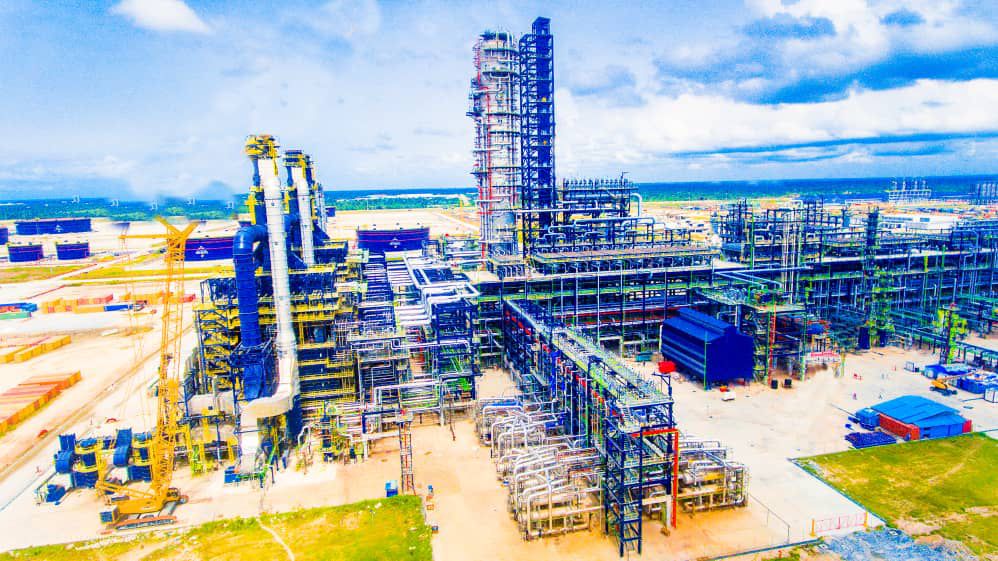
The Chief Executive Officer of the Dangote Refinery and Petrochemical, David Bird, has revealed that the $20 billion facility is scaling up its storage, logistics and maritime infrastructure, with plans to receive about 600 vessels annually as operations reach full capacity.
Speaking to members of the Maritime Correspondents’ Organisation of Nigeria (MARCON) after a tour of the facility, Bird said the refinery’s coastal location and deep-sea access were deliberately designed to support efficient import and export operations.
According to him, the merchant refinery model adopted by the facility relies heavily on maritime operations rather than a single crude pipeline. He explained that the refinery sources feedstock globally and transports it by sea, while finished products are distributed both domestically and internationally through maritime channels.
“This is not a refinery sitting at the end of a crude pipeline. All of our feedstock is imported by sea, and our products can go into Nigeria or out to the global market. That is the standard merchant refinery model,” Bird said.
He noted that the projected vessel traffic presents significant opportunities for job creation, local content development and logistics growth.
On the possibility of entering full-scale shipping operations, Bird said the company is keen on strengthening control over its supply chain. He disclosed that the firm has progressed from sourcing vessels on the open market to time-chartering ships, with outright vessel acquisition under consideration once sufficient cash flow is achieved.
He linked this strategy to the group’s Pan-African expansion drive, including plans for a tank farm in Namibia and ongoing engagements in Cameroon and Ghana to secure reliable product distribution outlets across the continent.
Port Infrastructure and Offshore Operations
An engineer in the Maintenance Planning Department and one of the tour guides, Victor Ngangha Oyama, explained that the Dangote Port—initially constructed as a jetty to receive specialised equipment during the refinery’s construction—has evolved into a full import and export hub.
The port currently handles fertiliser exports to countries such as Brazil, receives raw materials and is undergoing expansion to accommodate increased vessel traffic as operations scale up.
Providing further details, the Head of Marine, Petroleum and Petrochemical at the refinery, Captain Satendra Singh Rana, outlined the facility’s offshore marine infrastructure. He disclosed that the refinery operates five Single Point Mooring (SPM) buoys offshore—two dedicated to crude oil and three to refined products—linked by 48-inch pipelines buried two metres beneath the seabed for safety.
Rana said the crude SPMs can accommodate Very Large Crude Carriers (VLCCs) carrying up to two million barrels, with some vessels delivering as much as three million barrels in a single shipment.
He added that the system is engineered for rapid turnaround, with most vessels processed within 24 hours and larger tankers within 36 hours. The refinery has already handled about 800 tankers, which he described as a major milestone for a new refinery-terminal operation.
“With the refinery ramping up to 650,000 barrels per day, we expect about 600 tankers per year, combining crude and products,” Rana said.
He further noted that the offshore design utilises natural water depths of up to 40 metres for crude and 20 metres for products, eliminating the need for maintenance dredging. The SPMs and telemetry systems, he added, were designed and manufactured by a Houston-based company in the United States and rank among the highest-rated safety systems in global maritime energy trade.