EFCC Chairman Raises Alarm Over Funding Gaps, Appeals to Senate for Support
By Titilope Johnson
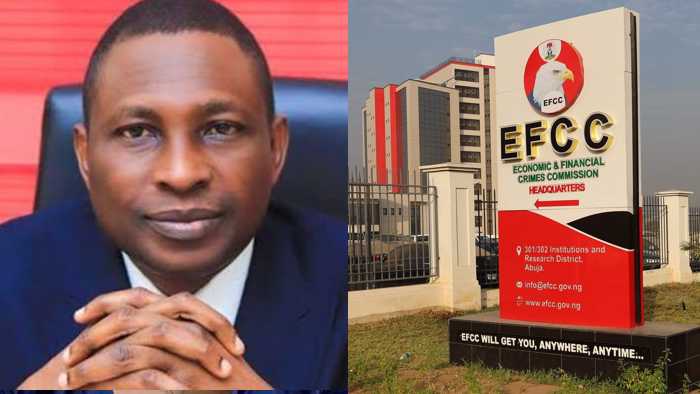
The Chairman of the Economic and Financial Crimes Commission (EFCC), Ola Olukoyede, has expressed concern over inadequate funding, warning that it could undermine the commission’s capacity to effectively discharge its mandate.
Olukoyede made the disclosure on Tuesday ahead of plenary while appearing before the Senate Committee on Anti-Corruption and Financial Crimes, chaired by Senator Emmanuel Udende, to present the EFCC’s expenditure performance for the 2025 fiscal year and its budget proposals for 2026.
According to him, only 50 per cent of the commission’s capital allocation for 2025 was released, a situation he said has adversely affected critical operations.
The EFCC chairman revealed that contractors handling commission projects are yet to be paid, while licence providers crucial to investigative activities have also not been serviced.
“We are afraid contractors have not been serviced, even the licence providers, and that will be a major problem for us this year because we need those licences to continue our work seamlessly,” he said.
He disclosed that the EFCC received an approved appropriation of ₦92.22 billion for the 2025 fiscal year, out of which 74 per cent had been released as of December 31, 2025.
Olukoyede further explained that the Federal Government operates an envelope budgeting system, which limits agencies to predetermined spending ceilings.
As a result, the commission’s proposed capital expenditure for 2026 stands at ₦22.8 billion, representing about 70 per cent of the previous year’s capital allocation.
He noted that outstanding payments for completed capital projects have led to the abandonment of several projects, adding that the matter has been formally reported to the Accountant-General of the Federation.
The EFCC chairman also appealed for an upward review of the commission’s overhead costs to enable more efficient operations.
He urged the Senate to strengthen its partnership with the commission in the collective effort to build a corruption-free Nigeria.





