Buhari’s Legacy Under Scrutiny as Emefiele, Ex-Ministers Face ₦3.5 Trillion Graft Probe
Several senior figures linked to the administration of former President Muhammadu Buhari are facing investigations and prosecutions over alleged corruption amounting to an estimated ₦3.47 trillion.
The scale of the allegations—emerging amid the heavy debt burden left by the Buhari administration—has reignited debate over accountability, selective justice and the true cost of the former president’s eight-year tenure.
At the centre of the controversy are former ministers and top officials widely regarded as close allies of the late president and members of the ruling All Progressives Congress (APC).
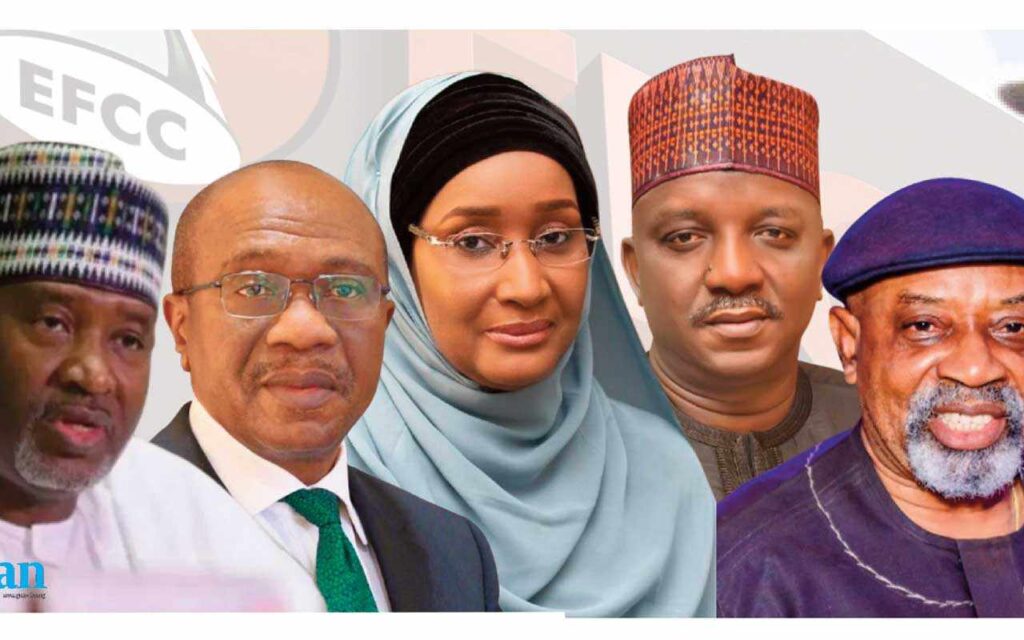
The Economic and Financial Crimes Commission (EFCC) is investigating former Minister of Labour, Chris Ngige, over an alleged ₦2.2 billion fraud. In November, the commission declared former Minister of State for Petroleum Resources, Timipre Sylva, wanted in connection with an alleged ₦21.4 billion fraud. Sylva served under Buhari, who was also the substantive Minister of Petroleum Resources.
Former Minister of Aviation and close political associate, Hadi Sirika, is similarly facing charges over an alleged ₦2.7 billion fraud linked to aviation projects.
The most extensive allegations involve former Central Bank of Nigeria (CBN) governor, Godwin Emefiele. The EFCC accuses him of arbitrarily allocating ₦3 trillion in foreign exchange—about $2 billion—without competitive bidding or due process, allegedly granting undue advantages to associates.
Investigators further allege that Emefiele operated 593 bank accounts across several countries, unlawfully acquired a 753-unit housing estate in Abuja and illegally mismanaged more than ₦16 billion.
Court filings indicate that between 2019 and 2022, Emefiele allegedly warehoused funds in proxy accounts linked to Kelvito Integrated Services—₦167 million in 2019, ₦1.23 billion in 2020, ₦2.94 billion in 2021 and ₦1.98 billion in 2022—totalling over ₦6.3 billion. An additional ₦900 million was allegedly held in an Ifeadigo Integrated Services account.
The EFCC also claims that a request for the payment of $6.2 million (about ₦8.8 billion) to foreign election observers was forged.
Beyond the financial sector, the EFCC is prosecuting former Minister of Power, Saleh Mamman, who is facing a ₦33.8 billion money-laundering trial. Similarly, the Ministry of Humanitarian Affairs, Disaster Management and Social Development, under former minister Sadiya Umar-Farouk, is accused of laundering ₦37 billion meant for social intervention programmes.
Altogether, the naira-denominated allegations total about ₦471 billion. When the alleged $2 billion forex allocation is included, the figure rises to approximately ₦3.47 trillion, underscoring the magnitude of the cases confronting anti-graft agencies.
The timing of the prosecutions has renewed scrutiny of fiscal stewardship under Buhari. Nigeria’s total debt stood at $65.42 billion in December 2015, rose to $84.57 billion by 2019, $87.24 billion in 2020 and $95.77 billion by June 2021. By the end of 2022, total debt had reached ₦46.25 trillion, with estimates suggesting that Buhari handed over about ₦77 trillion in total debt by May 29, 2023.
Analysts argue that the corruption allegations cannot be separated from the debt narrative. Critics say aggressive borrowing, weak oversight and opaque monetary interventions created room for abuse, while supporters of the former administration insist that many EFCC actions are politically motivated.
As investigations continue, observers say the cases will test not only the credibility of Nigeria’s anti-graft institutions but also the country’s willingness to address systemic failures that allowed corruption to thrive alongside unprecedented borrowing.
Professor of Economics at the University of Nigeria, Nsukka, Emmanuel Nwosu, said the scale of alleged fraud exposes deep flaws in public sector accounting and auditing.
“If people can be charged with corruption to the tune of ₦3 trillion, something is fundamentally wrong with public finance systems,” he said, questioning the utilisation of savings from fuel subsidy removal.
Governance expert Prof. Chiwuike Uba warned that alleged looting of borrowed funds directly harms citizens through higher taxes, inflation and deteriorating public services, while former CIBN president, Prof. Segun Ajibola, urged anti-corruption agencies to prioritise mega frauds and adopt tougher laws similar to China’s zero-tolerance approach.
Professor of management and accounting, Prof. Godwin Oyedokun, described the allegations as systemic, noting that future generations would repay debts without corresponding development.
Legal practitioner Ameh Madaki criticised the EFCC for selective prosecution, arguing that many high-profile cases amount to media trials that rarely end in convictions.
Experts agree that Nigeria must move from reactive probes to preventive reforms, including stronger public financial management, transparent procurement, real-time auditing of borrowed funds and genuine independence for oversight institutions.