SAFE AI Launch Experience Sets New Standard for User-Level AI Safety
By Titilope Johnson
GBEMISOLA-ADETAYO-SAFE-AI-LAUNCH-EXPERIENCE
The SAFE AI Launch Experience, held over the weekend in Springfield, Missouri, delivered a timely intervention in the ongoing global conversation on responsible artificial intelligence adoption. The event—tagged Balancing Innovation with Human-Centered Flourishing: Technology for the Good of All—highlighted the urgent need to protect everyday users as AI becomes embedded in work, communication, learning and family life.
At the centre of the event was the formal introduction of the AI User Safety Initiative, founded by Dr. Gbemisola Adetayo, an AI Security and Governance Professional and AI Systems Architect. Her work draws attention to a largely overlooked dimension of AI governance: the wellbeing and safety of non-technical, everyday users who are adopting AI tools at unprecedented speed. This demographic includes adults, children, students, professionals and families—yet global guardrails for safe consumer-level AI engagement remain limited.
The Initiative positions itself as a global community promoting responsible AI use in daily life. It addresses issues such as cognitive over-reliance, emotional displacement, misinformation exposure and declining independent thinking—concerns often overshadowed by enterprise-focused policy debates. Dr. Adetayo’s work returns the spotlight to those who interact with AI the most: end users.
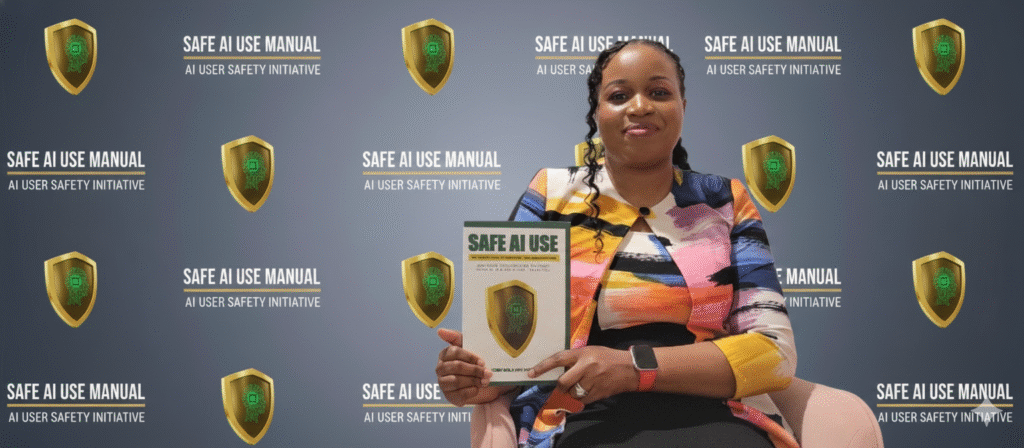
SAFE AI MANUAL BOOK
A key highlight of the event was the unveiling of the SAFE AI USE Manual, a practical guide designed for non-technical users seeking to benefit from AI without compromising critical thinking, mental clarity or personal wellbeing. Built on the SAFE AI Framework, the manual explains how users can evaluate AI outputs, maintain thinking independence, avoid unhealthy attachment to AI tools and establish healthy digital boundaries. Attendees praised the manual for its clarity and relevance.
The event also featured two thought-leadership panels exploring ethical AI use, the psychology of human-AI interaction and the responsibilities of creators and professionals as automation increasingly shapes human behaviour. The discussions reinforced that AI safety is no longer a purely technical concern—it is now a public wellbeing issue affecting homes, schools and workplaces.
One of the most engaging moments was the live demonstration of the AI User Wellbeing and Safety Self-Assessment Tool. The interactive assessment helps individuals understand how AI shapes their decisions, attention patterns and emotional responses. Participants described it as eye-opening, especially for parents, educators and professionals seeking to use AI without losing control of their thinking processes.
The-SAFE-AI-FRAMEWORK
The event concluded with a roadmap for applying the SAFE AI Framework across everyday contexts. Individuals can use it to maintain healthy digital habits; professionals can adopt it to structure ethical workflows; and families can apply it to guide children toward safe, balanced AI use. The framework is designed to be simple, actionable and accessible.
For Nigeria—where youth digital adoption is rising and AI tools are increasingly part of learning and communication—the conversation is especially timely. Many households and schools are navigating digital choices that did not exist a decade ago. The SAFE AI Launch Experience provides tools that speak directly to these emerging realities.
The Guardian Nigeria has long championed issues such as digital governance, ethical innovation, youth safety and responsible leadership. The emergence of user-level AI safety aligns closely with these priorities. As the AI User Safety Initiative expands globally, it presents new opportunities for public education, policy dialogue and sustained journalistic engagement.
For editorial partnerships, interviews, or access to the SAFE AI USE Manual, contact:
Gbemisola Adetayo
info@aiusersafety.org
www.aiusersafety.org