Chaos in Abuja as Police Disperse #FreeNnamdiKanu Protest, South-East Shuts Down in Solidarity
By Titilope Johnson
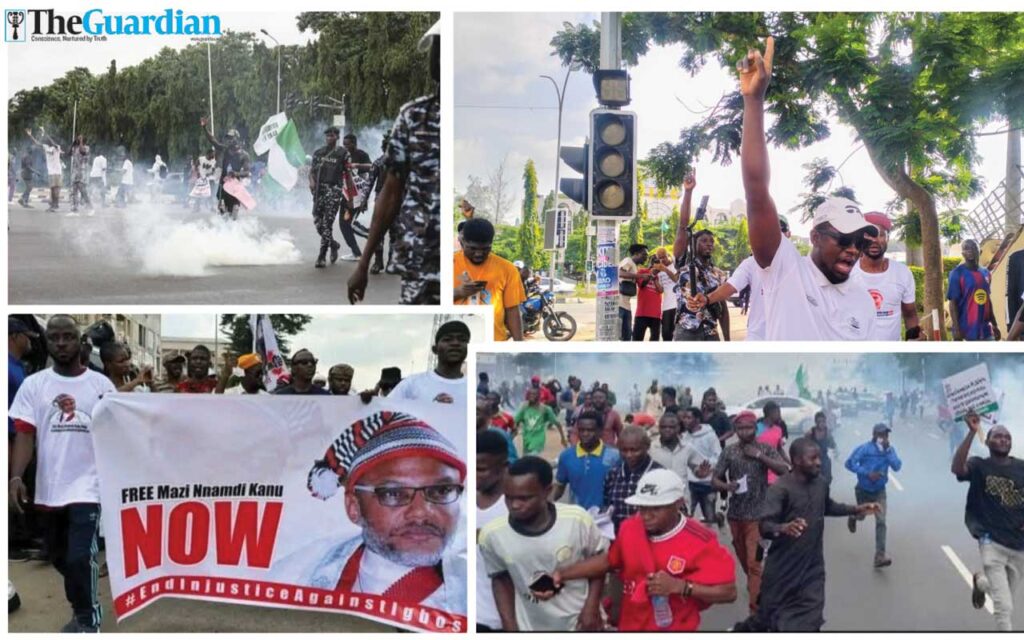
Security operatives yesterday used live bullets and teargas to disperse protesters in Abuja demanding the release of detained Indigenous People of Biafra (IPOB) leader, Nnamdi Kanu.
Simultaneously, economic and social activities across the South-East came to a halt as residents in Enugu, Ebonyi, Abia, Anambra, and Imo states observed sit-at-home actions or participated in peaceful marches supporting the #FreeNnamdiKanu campaign.
The Abuja protest, convened by activist and Sahara Reporters publisher, Omoyele Sowore, began near Transcorp Hilton but turned chaotic when police and soldiers intervened. Demonstrators regrouped at Utako Market, but security forces again fired teargas and bullets into the air, forcing traders and commuters to flee.
Shops and offices shut down as major roads leading to the Three Arms Zone were barricaded. Commuters faced hours-long gridlock, and several protesters—including Kanu’s brother and one of his lawyers—were reportedly arrested.
Sowore accused police of brutality and arbitrary arrests, warning of a nationwide revolt if the government continued to ignore court orders for Kanu’s release.
Police spokesman, CSP Benjamin Hundeyin, defended the operation, citing a Federal High Court order restricting protests near sensitive locations such as Aso Villa and the National Assembly. He said eight people were arrested for defying lawful directives and insisted that teargas deployment was a “standard operational procedure.”
By midday, calm had returned to most parts of Abuja, though heavy security presence persisted. A counter-protest also emerged, with demonstrators supporting Kanu’s continued trial and carrying placards reading “No Pressure to the Rule of Law.”
Across the five South-Eastern states, cities were deserted as residents stayed home in solidarity with Kanu.
In Enugu, markets and schools were closed; in Abia, Aba was completely locked down; in Ebonyi and Imo, deserted streets reflected the depth of public frustration. Anambra recorded near-total compliance as security operatives patrolled major roads without incident.
Observers described the widespread shutdown as evidence of the IPOB leader’s enduring influence and public resentment over his prolonged detention despite court orders for release.
Presidential aides Bayo Onanuga and Sunday Dare criticised Sowore’s protest, calling it an attempt to pressure the judiciary. Onanuga urged disciplinary action against Kanu’s lawyer, Aloy Ejimakor, for allegedly breaching legal ethics by joining the protest.
Dare said Sowore’s tactics were “unacceptable in a democracy” and insisted that no such protest would be tolerated in Europe or America. He reaffirmed that Kanu’s trial predates the Tinubu administration and remains under judicial jurisdiction.
The Lagos APC chapter also denounced the protest as “politically motivated,” accusing opposition figures of exploiting Kanu’s case for relevance. The party urged Nigerians to support peace and the President’s Renewed Hope Agenda.
Court activities in Abuja were paralysed as hearing in the police suit against Sowore and others was stalled due to a lockdown at the Federal High Court.
Meanwhile, in Kanu’s main trial, the Nigerian Medical Association reported that he was fit to stand trial, dismissing claims of life-threatening illness. Justice James Omotosho granted Kanu’s defence team six days to present its case.
Kanu faces seven amended terrorism-related charges, with proceedings set to resume later this month before Justice Binta Nyako.
The Committee for the Defence of Human Rights (CDHR) condemned the police for disrupting a peaceful protest, describing it as “an unacceptable abuse of power.”
CDHR President Debo Adeniran demanded the release of arrested protesters and warned that suppressing dissent could worsen national tensions.





