Bureaucratic Bottlenecks Stall Distribution of N50bn Farm Tractors
By Titilope Johnson
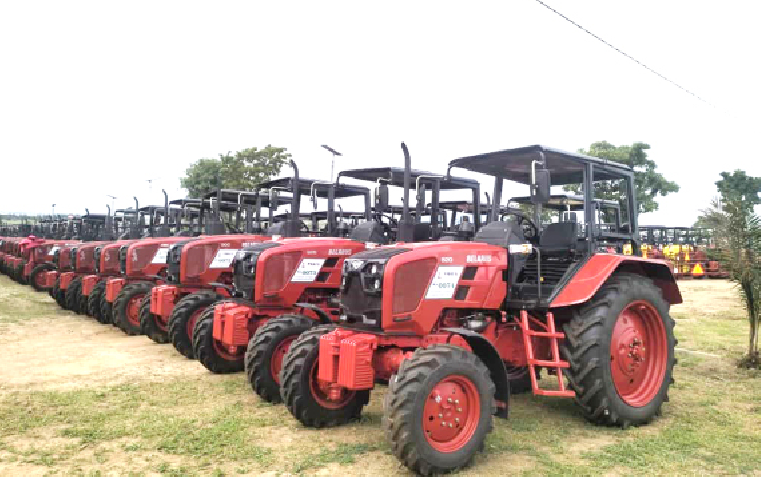
Tractors still awaiting distribution at the National Agricultural Seed Council, along Abuja–Lokoja Road. PHOTO: Joke Falaju
Agricultural supplies gather dust at NASC headquarters
Farmers lament delays, await sharing formula
Ministry awaits presidential directive on distribution
Agric operations are time-bound; tractors may miss planting season
Experts fault lack of maintenance plan for imported equipment
Nearly four months after President Bola Tinubu launched ₦50 billion worth of farm tractors to boost food production, the equipment remains idle—exposing Nigeria’s recurring pattern of stalled agricultural reforms, bureaucratic hurdles, and waste of public resources that undermine the government’s mechanisation agenda.
The machinery is currently gathering dust at the headquarters of the National Agricultural Seed Council (NASC). While there are no official details on the exact cost of the 9,022 machines imported from Belarus, The Guardian found that an average tractor costs about ₦28 million. This means the 2,000 tractors alone may have cost the country about ₦30 billion, even at a subsidised rate of ₦15 million each.
At the launch, President Tinubu unveiled 2,000 tractors, 2,000 disc ploughs and harrows, 1,000 disc ridgers, 1,200 tractor-trailers, 500 seed drills, 300 boom sprayers, 10 harvesters and 12 mobile workshop vehicles, among other spare parts. He described the initiative as a “monumental leap forward” to make agriculture more attractive to young Nigerians and to drive year-round cultivation.
However, over three months later, the Federal Ministry of Agriculture and Food Security says it is still awaiting directives from the Presidency on how the equipment will be distributed. A top ministry official, who requested anonymity, said distribution had not begun because the sharing formula is yet to be approved.
Another source noted that ministry activities have slowed significantly, with most decisions now coming directly from the Presidency. This uncertainty has dampened earlier optimism from Agriculture Minister Abubakar Kyari, who had announced plans to distribute the tractors through direct sales, leasing schemes, and community service centres, to make mechanisation accessible to farmers nationwide.
Meanwhile, farmers continue to grapple with rising labour and input costs. Daniel Okafor, Vice President of the All Farmers Association of Nigeria (AFAN), said they have received no updates on distribution:
“Farmers were very happy at the equipment launch. We thanked the government for that, but we are still waiting and monitoring the progress of the sharing formula,” he said.
Professor Simon Tuange of Joseph Sarwuan Tarka University, Makurdi, stressed the urgency of timely deployment, warning that if the tractors are not used during land preparation and planting, they may have to wait until the next farming season. He also criticised the lack of maintenance systems, urging the government to establish workshops alongside distribution to avoid breakdowns and abandonment.