Money Illusion Fuels Fiscal Crisis as States’ Debts, Deficits Soar
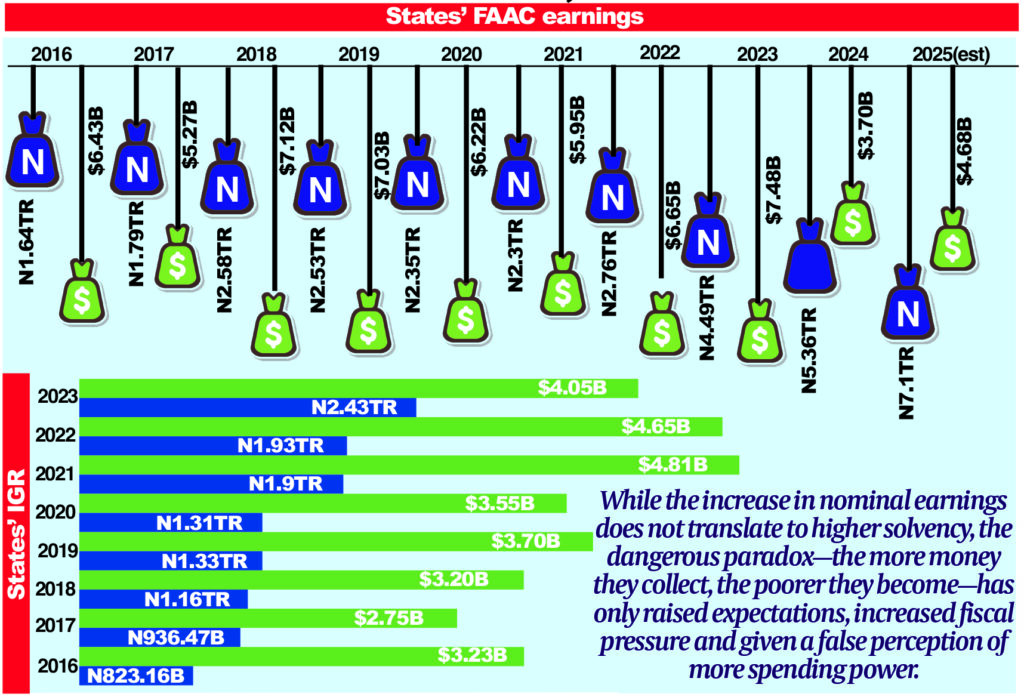
Nigeria’s state governments may be trapped in a money illusion — the deceptive sense of prosperity created by rising federal allocations that lose real value to inflation and naira depreciation.
While nominal earnings from the Federation Account Allocation Committee (FAAC) have increased, the purchasing power of these funds continues to erode. The paradox is stark: the more money states receive, the poorer they become in real terms.
From January to August 2025, state governments earned an average of ₦593.2 billion monthly from FAAC, about 33% higher than last year. Yet, when adjusted for inflation, real growth falls below 10%. In dollar terms, the monthly average translates to just $325 million, only a marginal increase from last year.
Meanwhile, costs of capital projects have soared. Cement prices rose by 35% within a year, and other inputs such as iron and labour climbed by as much as 40%. Rising recurrent expenses—particularly salaries under the new minimum wage—have further squeezed states’ ability to fund infrastructure.
By year’s end, FAAC inflows could reach ₦7.5 trillion, but inflation and currency weakness mean the real value remains far below 2022 and 2023 levels. Worse still, states carry over ₦3.87 trillion in domestic debts, billions in external loans, and arrears owed to contractors and workers.
Despite dwindling real revenues, states continue to adopt expansionary budgets. In 2023, total state expenditure hit ₦9.78 trillion, leaving a deficit of ₦2.86 trillion. This year, states and the FCT are targeting a combined ₦26.6 trillion expenditure, nearly quadruple projected FAAC receipts.
Even if internally generated revenue (IGR) grows to ₦3.45 trillion, total inflows would reach only ₦10.5 trillion—leaving a massive ₦16 trillion funding gap.
Data from BudgIT shows 32 states relied on FAAC for at least 55% of their revenue in 2023, while 14 states depended on it for over 70%. Lagos and a handful of tier-one states dominate IGR, leaving most sub-nationals fiscally fragile and increasingly dependent on overdrafts, bailouts, and borrowings.
At the heart of the crisis is the illusion of wealth created by rising allocations. Governors treat nominal windfalls as prosperity, ignoring the corrosive impact of high inflation, debt servicing, and currency devaluation. Without reforms in revenue generation and fiscal discipline, the illusion risks pushing many states closer to insolvency.







