Property Owners Abandon Title Registrations Over Bureaucracy and Corruption
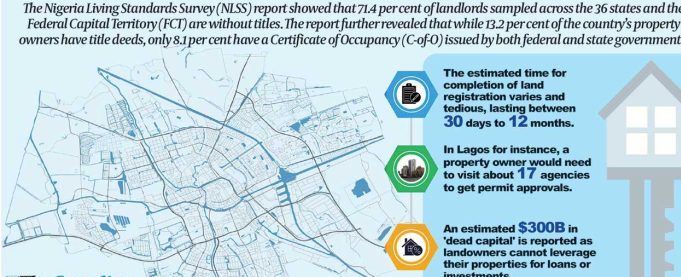
Nigeria’s real estate sector is facing a deepening crisis as property owners increasingly avoid registering land titles and Certificates of Occupancy (C-of-O), citing bureaucratic hurdles, high costs, and endemic corruption. Experts warn that over 90% of land across the country remains unregistered, rendering it economically dormant.
According to analysts, this has created an estimated $300 billion in ‘dead capital’, where property cannot be leveraged for credit, investment, or business expansion. Stakeholders say this threatens housing development, access to finance, and formal land ownership systems.
Red Tape and Corruption Undermining Reforms
Despite digital reform efforts by states and federal agencies, the land titling process remains complex, slow, and expensive. Across Lagos, Abuja, Ogun, Kano, Rivers, and Adamawa, property owners encounter mounting obstacles at various regulatory levels.
“Even after paying and submitting all documents, we waited six months without approval. Officers cited payment verification delays, despite using official channels,”
said Dr. Esther Oromidayo Thontteh, a Fellow of the Nigerian Institution of Estate Surveyors and Valuers.
Cost of Approval Discouraging Compliance
Documentation requirements—such as survey plans, land allocations, tax records, and environmental permits—are cumbersome. In some cases, multiple agencies impose overlapping fees. A developer in Lagos reported a ₦450,000 charge just for safety approvals, excluding standard permit fees.
“Approvals are becoming more about revenue than regulation,” said one frustrated developer.
Low Title Registration Rates Across Nigeria
The Nigeria Living Standards Survey (NLSS) revealed that only 8.1% of property owners possess a valid C-of-O, while 71.4% of landlords have no titles at all. In Lagos, just 22.9% of properties are officially registered, despite the state being considered a national leader.
State-by-state breakdown of C-of-O processing timelines:
- Lagos: 3 months to over 1 year
- Ogun: 3–4 years
- Osun: 1–3 years
- Oyo: 2–3 months
- Ondo/Ekiti: Up to 6 months
- Edo: About 60 days
Shocking Statistics Reveal Slow Progress
- In Lagos, only 246 C-of-Os were applied for in six years
- In Taraba, 392 C-of-Os were issued over 9 years
- Borno issued more C-of-Os in 2019 (1,000) than the prior 20 years combined
- FCT: 8,400 C-of-Os signed between 2010 and 2023, with 5,481 issued from May 2023 to Dec 2024
- Ekiti: 1,703 C-of-Os issued over 10 years
- Ogun (OLARMS): 700,000 structures registered since 2021, but actual C-of-O issuance remains low
Stakeholders Demand Urgent Reform
Speaking at a recent summit, former Lagos Governor Babatunde Fashola urged governments to stop using building approvals as a revenue stream, warning that excessive regulation stifles formal development.
Muyiwa Adelu, past President of the Association of Town Planning Consultants of Nigeria (ATOPCON), criticized the delays:
“We’ve had to tell clients long stories because of approval delays. This discourages others from applying. Technology should simplify the process, not complicate it.”
Akintoye Adeoye, President of REDAN, added:
“The Land Use Act provides a solid legal framework, but its poor implementation fuels inefficiency and corruption. Government must digitise and streamline land titling.”
Adele Adeniji, President of FIABCI Africa & Near East Region, echoed these concerns:
“Civil servants sit on applications for weeks. The government must ensure digitisation is not just cosmetic. Without title documentation, real estate cannot thrive, nor can people access credit.”
The Way Forward
Experts agree that improving land administration is critical for unlocking Nigeria’s vast property potential. Recommendations include:
Simplifying title registration processes
Deploying competent personnel in approving agencies
Eliminating multiple layers of regulation
Expanding digital platforms for land data management
Ensuring transparency and accountability at all stages





