“Dreams Deferred: Chinese Students Face Uncertainty Amid Aggressive US Visa Crackdown”
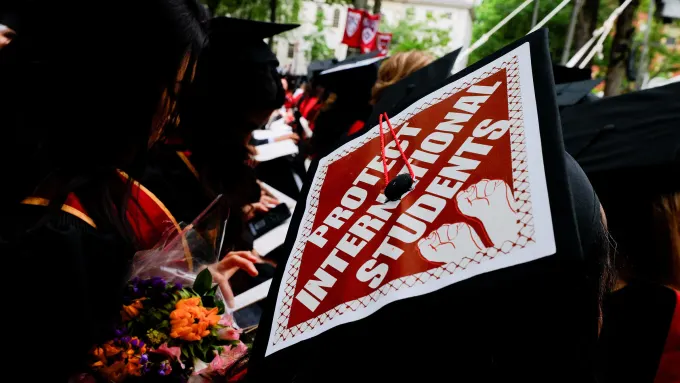
Kiwi Zhang, a Chinese computer science PhD student, had high hopes for his future in the United States—until last week when his visa was revoked at the US border.
Zhang, who had just presented his research at an academic conference in Asia, was returning to his university in the central US when he was detained for 48 hours. His phone and laptop were confiscated. He was interrogated about alleged ties to the Chinese Communist Party and contacts made while in China. The outcome: deportation and a five-year entry ban on suspicion of sharing research with the Chinese government—an accusation he denies.
“I never imagined this could happen to me,” said Zhang, who, like others interviewed for this story, used a pseudonym out of fear of retaliation. “This administration is jeopardizing my academic future, and I feel powerless.”
His experience reflects a growing wave of anxiety among Chinese students in the US following the Trump administration’s new vow to “aggressively revoke visas for Chinese students,” especially those with links to the Communist Party or studying in “critical fields.”
The vague announcement by Secretary of State Marco Rubio has sparked confusion, panic, and anger among students, education consultants, and Chinese officials. Many fear that years of effort and investment may be undone by geopolitical tensions.
‘A Politically Motivated and Discriminatory Move’
China’s foreign ministry condemned the policy, accusing the US of hiding behind national security to justify “politically motivated and discriminatory” actions. Online forums and student chat groups erupted with disbelief, while many students voiced frustration and fear on social media.
For Joyce, a Chinese student accepted to Harvard’s architecture master’s program, the situation feels surreal. Though her current visa remains valid, she’s afraid to visit family in China, fearing reentry denial.
“I can’t help wishing I’d grown up in a golden age of US-China relations,” she said.
Escalating Tensions, Collapsing Plans
Chinese students once represented the largest group of international students in the US, fueling scientific research and contributing to the economy. But rising geopolitical tensions and mutual distrust are now upending those long-standing academic ties.
Trump’s earlier 2020 executive order already barred visas for STEM graduates from Chinese institutions with alleged military links. That order led to over 1,000 visa revocations within three months and remained in place under the Biden administration. Now, students fear the new wave of restrictions could be even broader.
David Yang, a theoretical chemistry PhD student in the Midwest, said Rubio’s announcement stunned him and his classmates. “We lost the motivation to even finish our assignments,” he said. “The constant changes bring so much uncertainty—it affects your mental health and your work.”
Harvard Targeted
The anxiety intensified after the Trump administration barred Harvard University from enrolling international students, accusing it of coordinating with the Chinese Communist Party. Although a federal court later blocked the move, the State Department ordered US embassies to pause new student visa appointments.
Yang said he now compulsively checks news updates and has canceled plans to visit China this winter. He fears that his field of study could make him a target—and like many Chinese students, he’s a member of the Communist Youth League, a standard affiliation among Chinese students aged 14–28.
“This policy is like condemning all Chinese students with one stroke,” he said.
Zhang, meanwhile, was interrogated about his parents’ Communist Party membership and his own affiliations. “I said there were no real activities. They accused me of lying,” he said. “I was stunned.”
Seeking Alternatives
Facing an uncertain future, some students are exploring options in Europe or Asia. Ella Liu, a University of Michigan math student, is scheduled to begin a summer research program in the US but fears being barred entry when she travels from her hometown in Guangzhou.
“If this policy continues, I may have to transfer to a university in France or Hong Kong,” she said.
Chinese families, many from middle-class backgrounds, often save for years to afford a US education. But growing restrictions and anti-China sentiment are prompting a reevaluation. Education counselors report a surge in inquiries about schools in the UK, Canada, Australia, and Hong Kong.
Nelson Urena Jr., an education consultant in Shanghai, said more families are questioning the safety and viability of a US education amid gun violence, racial tensions, and visa unpredictability.
“Parents are wondering: ‘Is my child welcome in the US?’” he said. “Now the options feel limited. Do they take a gap year? Apply elsewhere? Start over?”
A Fading Era of Openness
Despite the turmoil, some Chinese families still see the US as the pinnacle of education. Arno Huang, a businessman from Fujian, hopes to send his children to the US after their undergraduate studies in Hong Kong.
“The US is one of the most open and developed countries in the world,” he said. “Having your child study there gives a family pride and social status.”
Zichen Wang, a fellow at the Beijing-based Center for China and Globalization, lamented the loss of an era when Chinese scholars trained in the US returned home with admiration for American openness and innovation.
“What makes America great is its openness—its universities, its marketplace of ideas, and its ability to attract talent,” Wang said. “That’s what the world admires.”





https://shorturl.fm/FIJkD
https://shorturl.fm/FIJkD
https://shorturl.fm/68Y8V
https://shorturl.fm/hQjgP
https://shorturl.fm/eAlmd