Two Years of Tinubu’s Presidency: Praise, Protests, and Projections
By: Titilope Johnson
• Onaiyekan: ‘If Tinubu continues like this, he won’t win free, fair election’
• Buhari hails President, urges Nigerians to be patient with reforms
As President Bola Ahmed Tinubu marks the second anniversary of his administration, the nation remains deeply divided over his economic and political performance. While the President touts progress, opposition parties, religious leaders, and former officials express discontent, warning of worsening living standards and disillusioned citizens.
Tinubu Defends Reforms: “Our Economic Agenda Is Working”
Speaking confidently on his administration’s trajectory, President Tinubu declared:
“I proudly affirm that our economic reforms are working. We are on course to building a greater, more economically stable nation.”
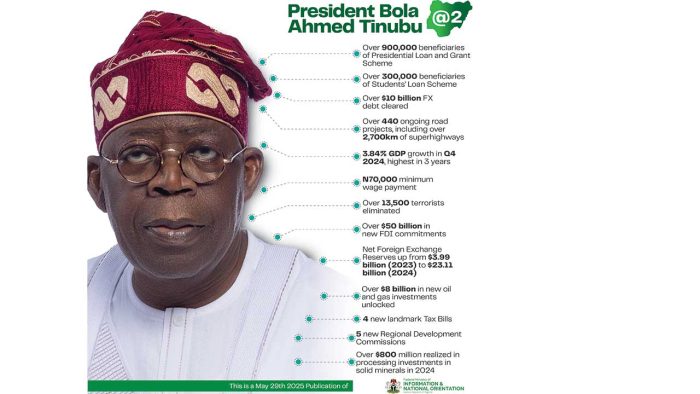
He highlighted achievements under the Renewed Hope Agenda, citing reduced fiscal deficits, increased oil sector investment, declining inflation, and rising foreign reserves.
Key accomplishments include:
- Inflation relief: Food prices, particularly rice, have reportedly declined.
- Oil boom: Rig counts up 400% since 2021, with $8 billion in new investments.
- Revenue gains: Over ₦6 trillion generated in Q1 2025.
- Foreign reserves: Rose from $4 billion in 2023 to over $23 billion in 2024.
- Fiscal tightening: Debt service-to-revenue ratio dropped below 40%.
“The alternative to these reforms would have been a fiscal crisis marked by runaway inflation, external debt default, and economic collapse,” Tinubu emphasized.
Opposition Fires Back: ‘Tinubu’s Reforms Are Anti-People’
The Peoples Democratic Party (PDP) strongly condemned the administration, citing:
- Soaring fuel prices (₦87 → ₦1,000+ per litre)
- Naira devaluation (₦167 → ₦1,600/$1)
- Inflation nearing 40%
- Youth unemployment over 42%
- Over 600,000 deaths linked to insecurity since May 2023
In a blistering statement, PDP spokesperson Debo Ologunagba said:
“This government is anti-people and impervious to the suffering of Nigerians. The nation is groaning under food scarcity, rising poverty, and oppressive policies.”
The PDP accused the administration of “reckless borrowing” and “elite excesses,” noting Nigeria’s debt now exceeds ₦182.91 trillion, with another ₦38.24 trillion in foreign loans requested.
Onaiyekan: ‘Living Standards Have Crashed’
Cardinal John Onaiyekan, Archbishop Emeritus of Abuja, issued a grave warning:
“If President Tinubu continues like this, he will not win a free and fair election.”
Speaking at the National Communications Week Lecture in Abuja, he criticized the worsening economic conditions and rising insecurity, urging the President to listen to ordinary Nigerians—not just his advisers.
“How are families surviving on ₦30,000 monthly salaries? The well-being of Nigerians has crashed considerably in the past two years.”
Onaiyekan implored the President to:
- Tackle insecurity
- Target policies toward the poor
- Restore trust in government
He added:
“Now that the election is over and the Supreme Court has affirmed his win, he should stop campaigning and focus on governance.”
Atiku, Opposition Coalition: ‘A Government of Disconnect and Excess’
Former Vice President Atiku Abubakar and opposition figures, including Dr. Salihu Lukman, lambasted the administration, calling it:
“One of the most incompetent, disconnected, and anti-people governments in Nigeria’s democratic history.”
The coalition warned of:
- Worsening food insecurity (Nigeria now ranks 18th globally in the Hunger Index)
- Crippling hikes in public service costs (NIMC fees, university tuition)
- Debt crisis: From ₦49 trillion in 2023 to ₦144 trillion in 2025—a 150% surge
The opposition dismissed new loan requests as unjustified and accused the government of “creating a class-based system” that marginalizes the poor.
Buhari Urges Patience, Endorses Tinubu’s Vision
In contrast, former President Muhammadu Buhari praised Tinubu’s leadership:
“Reforms take time. The hardship is not without purpose. Nigerians must remain patient.”
Via his spokesperson Garba Shehu, Buhari stressed unity and urged citizens and the private sector to support government efforts.
“Our expectations from government should not become too heavy. Nation-building is a shared responsibility.”
Conclusion: A Divided Anniversary
As Nigeria marks two years under Tinubu’s leadership, the nation stands at a crossroads. While the government defends its long-term strategy and structural reforms, critics argue that the present hardship is too great, the public discontent too loud, and the social divide too wide to ignore.
The next two years may define not just Tinubu’s legacy—but Nigeria’s future.