World Bank Acknowledges Nigeria’s Economic Gains, Warns of High Prices and Ambitious Targets
The World Bank has acknowledged Nigeria’s modest economic progress, citing improvements in macroeconomic indicators such as stabilised foreign reserves, increased business confidence, and a rise in public revenue-to-GDP ratio from 8.8% to 13.3% in 2023. However, it also warned that high inflation and unrealistic budget projections threaten the country’s development ambitions.
At the launch of its bi-annual Nigeria Development Update (NDU), themed “Building Momentum for Inclusive Growth,” the World Bank revealed that while growth has returned, the country remains far from achieving its $1 trillion economy target by 2030. Based on current growth rates, it could take 11 more years — until 2036 — to reach that milestone.
The report noted that Nigeria’s economy grew by 3.4% in 2024, the fastest rate since 2014 outside of post-COVID recovery years. In nominal terms, the economy expanded from N229.9 trillion to N269.3 trillion — about $168.3 billion at prevailing exchange rates. Yet, without a sharp boost in real growth or a stable exchange rate, the $1 trillion goal remains elusive.
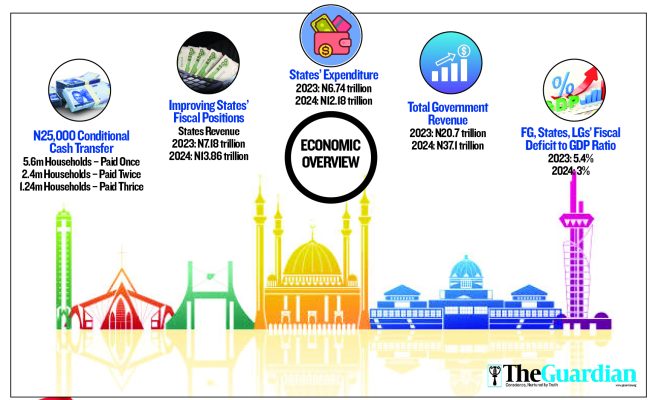
The World Bank praised recent reforms, including tighter monetary policy, FX unification, and improved revenue collection, which saw federation revenues jump from N16.8 trillion in 2023 to an estimated N31.9 trillion in 2024, and the fiscal deficit shrink from 5.4% to 3% of GDP. It also acknowledged improved fiscal performance at the state level, where the overall fiscal balance grew over 280% to N1.68 trillion.
Despite this, the Bank criticised the 2025 Federal Budget, calling it “overly ambitious” amid weak oil prices and lingering inflation. It warned that unrealistic revenue assumptions could lead to arrears and deficit monetisation, undermining macroeconomic gains.
The World Bank said inflation remains elevated, eroding household purchasing power. It advised further transparency in oil revenue management, reduced cost of governance, and increased investment in human capital, infrastructure, and social protection.
On Nigeria’s conditional cash transfer programme, it reported that 9.34 million households had received the N25,000 payments, though the rollout has been slow.
Speaking at the event, World Bank Acting Country Director, Taimur Samad, said Nigeria now has a “historic opportunity” to increase development spending. Lead Economist Alex Sienaert emphasised that the public sector alone cannot drive growth and must act as an enabler of private investment and job creation.
In response, Finance Minister Wale Edun underscored the need for sustained investment to drive productivity and job creation. Budget Minister Atiku Bagudu defended the ambitious budget, saying it is meant to challenge government institutions to do more.
CBN Governor Yemi Cardoso reaffirmed the bank’s orthodox monetary stance, urging Nigerians to engage more with economic data. He stressed that price and financial stability are crucial to long-term growth.
Meanwhile, Digital Economy Minister Bosun Tijani defended recent telecom tariff hikes, revealing that over $1 billion in infrastructure orders have been placed to enhance connectivity, driven by the new pricing regime.
While acknowledging progress, the World Bank urged Nigeria to deepen reforms, enhance transparency, and invest in inclusive sectors to ensure the economy not only grows but lifts millions out of poverty.