Insecurity, Hoarding, and Middlemen Push Rice Prices Soaring, Shut Down Local Mills
Ofada, Abakaliki, Big Bull, Kiara rice witness 100% spike as Nigeria struggles with supply deficits, mill closures
Despite federal government claims of increased investment and progress in local rice production, Nigeria remains far from achieving self-sufficiency. Soaring rice prices, mill shutdowns, and persistent insecurity have worsened food inflation and undermined national food security goals.
The price of local rice varieties has surged drastically, with a 50kg bag now selling for between ₦84,000 and ₦120,000, depending on the brand. Once affordable staples like Ofada, Abakaliki, Big Bull, and Kiara rice have become luxury items for many Nigerians. For instance, a 50kg bag of Abakaliki long-grain rice now costs ₦84,000, up from ₦19,000 in 2020. Ofada rice, sold at ₦13,000 in mid-2023, now goes for ₦21,000 per local bowl (olodo).
Despite being Africa’s largest rice producer, Nigeria still imports about 3.6 million metric tonnes annually to bridge the consumption gap. With local production at 8.9 million metric tonnes of paddy rice (or 5.2 million metric tonnes milled), and consumption at 7.7 million metric tonnes, the supply shortfall has sparked a price crisis.
Insecurity and Climate Impact
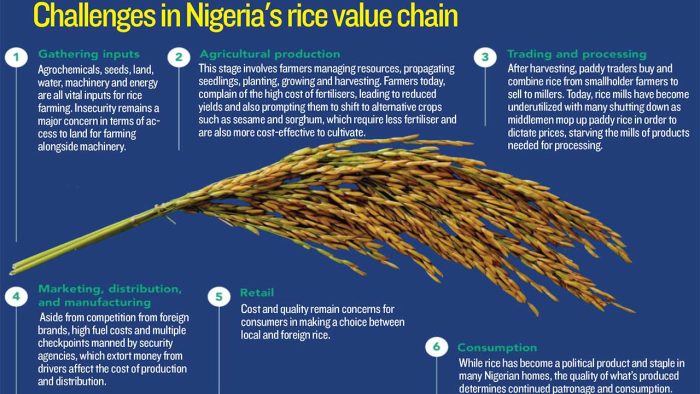
Key rice-producing states — Katsina, Kebbi, Jigawa, Kwara, and Sokoto — have seen a sharp drop in farming activity due to banditry and herder-farmer conflicts. Flooding has further damaged crops, while fertiliser costs have forced many farmers to switch to less demanding crops like sesame and sorghum.
According to the 2024 AFEX Crop Production Report, rice output is expected to fall to 8.1 million metric tonnes, down from 9.1 million in 2023, due to production constraints.
Hoarding and Middlemen Distort Market
Investigations show that millers and marketers now compete with wealthy private buyers who purchase paddy directly from farmers, creating artificial scarcity. Some hoarders stockpile rice in warehouses, waiting for scarcity periods to sell at inflated prices. This speculative buying distorts the market and drives up costs for genuine processors and consumers.
“Middlemen and political farmers who hoard or buy paddy from real farmers without contributing to cultivation inflate prices,” said Akeem Ojo, a rice farmer in Ogun State. “This makes rice unaffordable for ordinary Nigerians.”
Import Dependence Amid Local Initiatives
Although rice is cultivated in 29 out of Nigeria’s 36 states, the country still ranks as the third-largest global importer, purchasing over 2.1 million metric tonnes of rice annually. While several states have launched rice initiatives — including MITROS in Ogun, Eko Rice Mill in Lagos, and rice mills in Kebbi, Ebonyi, Bayelsa, and Delta — most have failed to deliver sustained results.
- Ogun’s MITROS Rice, launched in 2017 with much fanfare, fizzled out within a year, despite promises of improved Ofada rice production and foreign exchange earnings.
- Lagos’ Imota Rice Mill, the largest in Sub-Saharan Africa with a capacity of 2.8 million 50kg bags per year, has not met expectations due to paddy shortages and logistic challenges.
- Abakaliki Rice, once a household name, has disappeared from markets, despite its affordability and popularity during Nigeria’s import bans.
Even Nigeria’s high-profile rice pyramid initiative, which showcased 1.2 million bags in 2022, has had little lasting effect.
Transportation Woes, Political Appointments Add to Crisis
The cost of transporting rice has also increased significantly. A marketer in Kano reported spending ₦1.2 million to move a single trailer of rice to Abuja, citing fuel costs and extortion at security checkpoints.
Stakeholders say the politicisation of agricultural leadership, poor regulation, and limited investment in logistics and post-harvest management are compounding the crisis.
Policy Suggestions from Stakeholders
- Suleiman Dikwa, MD of Sahara Farms, called for tackling the 40% post-harvest losses and establishing commodity boards to regulate pricing.
- Grain merchant Musa Aliyu urged the government to pass an executive order to stop extortion by security agencies.
- Farmers say input support must be matched by honest distribution and price control, not political patronage.
With rising inflation, looming food insecurity, and crumbling local initiatives, experts warn that unless drastic measures are taken, Nigeria’s rice revolution risks becoming a failed dream.